
From an uphill lie in a bunker, set your shoulders so they roughly follow the slope, dig your feet in well, play the ball a little forward and splash the sand as you would for a normal bunker shot, letting the club swing up the slope after impact. The slope helps the ball get up quickly, so you rarely struggle with the lip, but the ball comes out higher and shorter. Make a longer, firmer swing than the distance suggests. If the ball is plugged in the face, the shot changes completely, which is covered further down.
Uphill bunker lies usually happen near the front face of a greenside bunker, where the sand rises up towards the lip. The good news is that this is one of the friendlier bunker lies. The slope does a lot of the work in getting the ball up over the lip. The common mistake is leaving it in the bunker anyway, or barely reaching the green.
Why it comes out high and short
The principle is the same as on grass. When your shoulders follow an upslope, the club travels upwards through the sand and the ball, adding loft. With a sand wedge that is already open, the ball pops almost straight up. That is great for clearing a steep lip, less so for getting it to a flag 20 yards away. The general rules for this slope are in how to hit off an uphill lie.
So the main adjustment on a normal uphill bunker lie is distance. You will need more swing than usual to send the ball the same distance.
Setting up
Feet
Dig in properly. On an upslope your back foot will be lower and will carry more weight, so work it into the sand until it feels solid. Your front foot will be higher up the slope. A slightly wider stance helps your balance.
Shoulders
Tilt your shoulders so they roughly match the slope, lead shoulder higher. This lets the club enter the sand behind the ball and travel up the slope through it, instead of crashing into the bank.
Weight
More of your weight will be on your back foot. That is the natural result of matching the slope, and it is fine. Do not fight it by forcing your weight forward. That tends to drive the club down into the sand and stop it dead.
Ball and face
Play the ball slightly forward of centre, as you would on a normal bunker shot, perhaps a fraction further forward. Open the face a little, but on a big upslope you may not need as much as normal, because the slope already adds loft. If the lip is low and the flag is a long way away, a squarer face will help the ball travel further.

The swing
Make your normal splash shot, entering the sand a couple of inches behind the ball. Let the club follow the slope up and out of the sand, so the finish is high.
Swing longer and firmer than you would for the same distance from a flat lie. This is the part that catches people out. The extra loft from the slope means the ball goes up more and forward less. Commit to a full follow-through.
Keep the club moving. Stopping at impact is the main reason the ball stays in the bunker. On an upslope it is easy to hit into the sand and feel the club stall, especially if your weight has crept forward.
Remember that you cannot touch the sand with your club before the stroke, either at address, on the backswing or in a practice swing. That is a penalty under the Rules of Golf. Take your practice swings outside the bunker, or hover the club above the sand.

When the ball plugs in the face
A ball that flies into the upslope of a bunker face often plugs, sometimes leaving a fried egg with sand all around it, sometimes buried in the bank itself. That is a different shot, and most coaches teach a different setup for it.
With a plugged ball near the face, a normal splash with an open face tends to skid off the top of the sand and leave the ball where it is. The usual advice is to lean into the slope, keeping more weight on the front foot and your shoulders closer to level, so the club can drive down into the sand behind the ball. Keep the face square or even slightly closed, so the leading edge digs in. Then hit hard into the sand just behind the ball and do not worry about a follow-through. The club will often stop in the sand.
The ball will come out lower and with little or no spin, so it will roll more than a normal bunker shot. Allow for that when you pick where you want it to land.
Coaches vary on the detail here, especially how closed to set the face, so if you get a lot of plugged lies it is worth practising both a square and a slightly closed face to see which works for you.
Very steep faces
If the ball is right against a steep face, you may not be able to make a full swing at all. Your back foot might be on flat sand and your front foot high up the bank. In those cases, the priority is getting out. Aim for any part of the green, or even out sideways if the lip is too steep. Taking one shot to get out is much better than two or three trying for the flag.
Sometimes you will not even be able to stand in the bunker properly. That situation has its own challenges, covered in ball in the bunker, feet outside it.
The mirror image of this shot, from a downslope in a bunker, is much harder. See bunker shots from a downhill lie.
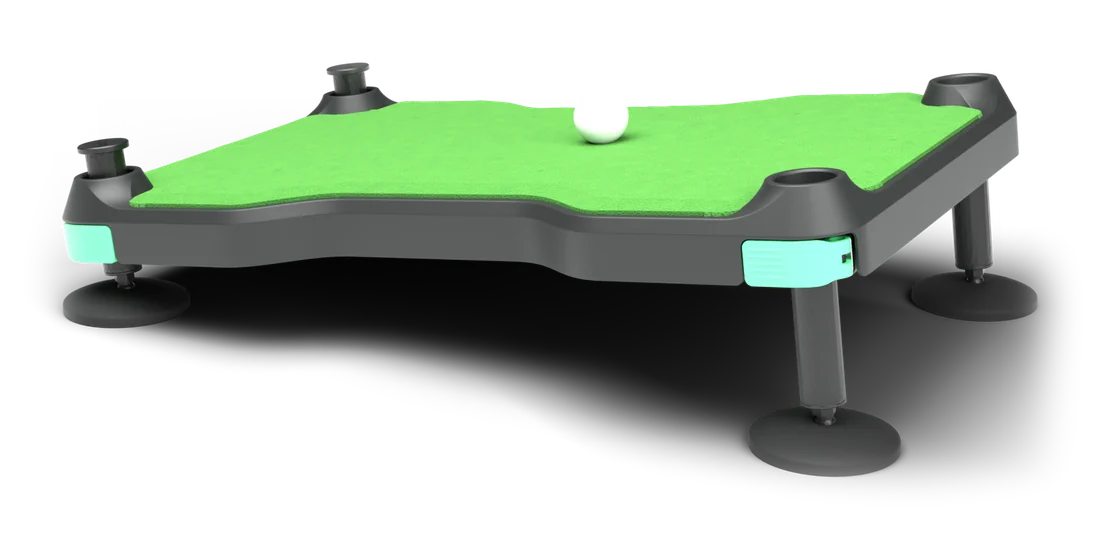
Libro cannot put sand under your feet, but it can help with the part of this shot most golfers never practise, which is standing and swinging on an upslope. It tilts up to 7 degrees along its length and sets with a cam lock in seconds, so you can rehearse the shoulder tilt and the balance at home before you need them in a bunker. You can reserve one for £10, fully refundable, ahead of Kickstarter in early 2027.