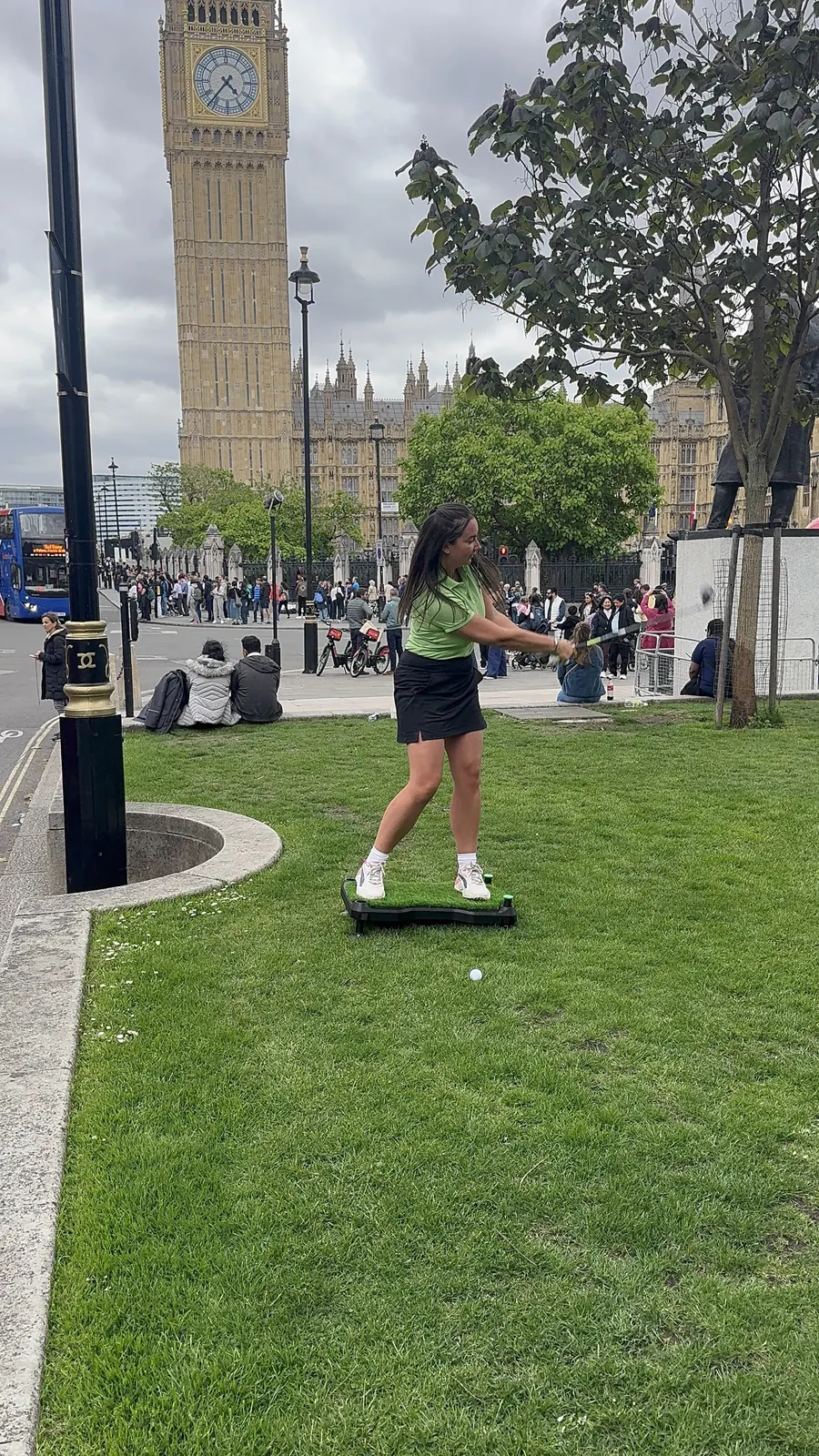
To practise like you play, make every practice ball look like a shot on the course. One ball, one target, your full pre-shot routine, no instant second go, and a lie that isn't always perfect. The more your practice looks like a round, the more of it you'll take to the first tee.
Most people know this. Very few do it, because it's slower and less fun than raking balls across and hitting them.
What changes between the range and the course
Have a think about what's different on a Saturday morning compared with a Tuesday night at the range.
On the course you get one go. You walk to the ball, you look at the lie, you check the yardage, you pick a club. You stand behind it and choose a target. You might be nervous. The ground under your feet is rarely level. Then you hit it, and whatever happens, you go and find it.
At the range you get unlimited goes, a perfect flat lie, no walking, and a pile of balls telling you the next one doesn't matter much. It's a completely different task.
You can't fix all of that. You can fix a lot of it.

Take the routine to the range
The single biggest change is using your pre-shot routine on every ball you care about. Not every ball in the session, but most of them.
If you don't have a routine, build a short one:
- Stand behind the ball and pick a small target.
- Pick an intermediate spot a yard or two in front of the ball on that line.
- One practice swing that matches the shot.
- Walk in, set the club behind the ball, feet, a last look, go.
Keep it roughly the same length every time. When you're nervous on the course, the routine is something familiar to hang onto. If you've only ever done it on the course, it won't feel familiar at all.
On sloping lies the routine needs one extra step, reading the slope before you choose a club. That gets its own post: a pre-shot routine for sloping lies.
One ball at a time
Move the basket out of reach. Seriously. Put it a few steps behind you so you have to walk to get the next ball. It slows you down and breaks the habit of hitting again straight away to "fix" the last one.
After each shot, say out loud or in your head what happened. Started left, curved right, a bit thin. Then walk back, start the routine again. Don't make a swing change between every ball. On the course you wouldn't.
Play holes
Pick the course you play most and play it on the range. Hole one: what do you hit off the tee? Where would that leave you? What's the second shot? Hit those in order, using targets on the range as fairways and greens.
If a drive "misses the fairway" in your head, play the next shot as a recovery. Punch a 7-iron low. Hit a 9-iron to the fat side of the green. Golf is full of shots you didn't plan, and the range is the place to practise them.
You can write a scorecard if you like. A fairway hit and a green hit, inside a target you've agreed with yourself, counts as a par. It sounds daft. It also makes you care, which is the whole idea.

Change the lie
This is the part almost nobody does, because ranges make it nearly impossible. Every bay is flat. Every mat is the same.
On the course, a lot of your shots are from some kind of slope. Fairways roll, rough sits on banks, the ball runs into hollows. If you only ever practise flat, your setup and ball position are tuned for a lie you hardly ever get outside the tee box.
What you can do:
- Grass ranges. Some have uneven ground at the edges or a short game area with banks. Use them.
- Practice ground at the club. If your club lets you hit from the rough near the practice area, find a slope.
- At home. A garden bank and a few foam balls teaches more than you'd expect about balance.
- Sim bays. Ask if they have a sloped mat. Or bring your own platform.
You don't need to hit dozens of sloping-lie shots. Five or six per session, mixed in with flat ones, is enough to keep your setup honest. The how-to for each slope lives in the main guides, starting with the four uneven lies.
Add a little pressure
Pressure is hard to fake, but a small consequence helps. A few ideas:
- Bet a pint with a mate on a nine-shot challenge.
- End the session with one ball. If it misses your window, you pick up the range balls by the bay.
- Keep a running score in a notebook and try to beat it next week. A golf practice journal makes this easy.
You won't feel what you feel on the 18th with a card in your pocket. You'll feel something, and that's better than nothing.
How much of a session should look like this?
It depends what you're working on. If you've just had a lesson, you'll need some plain repetition to get used to the new move. Once that feels settled, aim for at least half of every session to be "play" rather than "drill". The closer you get to the season, or to a comp you care about, the more it should lean towards play.
Changing the lie is the hardest part to bring indoors or to the range. Libro is a portable platform that tilts up to 7 degrees uphill or downhill and 13 degrees sidehill, with nothing to charge, and it works with any launch monitor or simulator. It's coming to Kickstarter in early 2027, and you can reserve one for £10, fully refundable.