
There are four basic uneven lies in golf: uphill, downhill, ball above your feet and ball below your feet. For a right-hander, uphill sends the ball higher and left, downhill sends it lower and right, ball above your feet sends it left, and ball below your feet sends it right. Almost every awkward lie you meet on the course is one of these, or two of them at once.
That sounds like a lot to remember. In practice, once you understand why each one happens, the right adjustments start to feel obvious. This guide gives you the overview and points you to the detailed post on each lie.
The four lies at a glance
| Lie | How you know | Ball tends to go | Key setup change |
|---|---|---|---|
| Uphill | Front foot higher | Higher, shorter, left | Shoulders with slope, ball a touch forward, more club |
| Downhill | Front foot lower | Lower, runs, right | Shoulders with slope, ball back, weight forward |
| Ball above feet | Standing below the ball | Left | Grip down, stand taller |
| Ball below feet | Standing above the ball | Right | More knee flex, wider stance, stay down |
All directions are for a right-hander. Left-handers, flip them.
How to tell which lie you have
It sounds daft, but a lot of shots on slopes are lost because the golfer did not properly notice the slope. Fairways can look flat from the tee and turn out to be anything but once you are standing on them.
Three quick checks help.
Feel it through your feet. Stand at address and notice where your weight goes. Pressure on your back foot means uphill. Pressure on your front foot means downhill. Weight pulled onto your heels means the ball is above your feet. Weight pulled onto your toes means it is below.
Look from behind. Before you walk up to the ball, stand behind it on the target line and look at the ground around it. It is much easier to read the slope from a few yards back than when you are standing over the ball.
Take a practice swing. Swing next to the ball, on the same slope, and see where the club brushes the grass. That shows you where your low point is, which tells you where to put the ball. It also tells you how balanced you are, which tells you how big a swing you can afford.
Uphill lie
Your front foot is higher than your back foot. The slope adds loft, so the ball flies higher and lands softer, and you lose distance. Most club golfers also pull the ball left, because their weight hangs back and their body struggles to turn through.
Set your shoulders roughly parallel to the slope, play the ball a little further forward than normal, take one or two more clubs, and aim slightly right. Swing up the hill and let your finish be a little higher than usual.
Uphill lies are generally the friendliest of the four. The slope helps the ball into the air, so even longer clubs can be playable. The full guide is how to hit off an uphill lie.

Downhill lie
Your front foot is lower than your back foot. The slope takes loft off, so the ball comes out lower and runs further. It tends to go right, and it is easy to top or thin because the ground behind the ball is higher than in front.
Tilt your shoulders with the slope, put more weight on your front foot, play the ball further back, and aim slightly left. Swing down the slope and stay down until the ball has gone.
Most golfers find downhill lies harder than uphill. Long clubs in particular can be very difficult to get airborne. The full guide is how to hit off a downhill lie.
Ball above your feet
The ground rises towards the ball, and you are standing below it. The toe of the club sits up, which points the loft of the face to the left, and your swing becomes flatter and more rounded. For a right-hander the result is a pull or a draw.
Grip down so the club fits the shorter distance to the ball, stand a little taller, keep your weight towards your toes, and aim right. The more lofted the club, the more it goes left, so wedges need more aim than mid-irons.
The full guide is ball above your feet.

Ball below your feet
The ground falls away from you towards the ball. The toe hangs down, the face points right, and your swing becomes more upright and restricted. For a right-hander the ball tends to go right, as a push or a fade.
Flex your knees more, bend further from the hips, widen your stance, hold the club at full length and aim left. Stay down through impact. Standing up is the most common reason for a thin or topped shot from this lie.
This is the lie most golfers like least. The full guide is ball below your feet.
When two slopes combine
Real golf courses rarely give you a pure slope. You will often find yourself on an upslope with the ball above your feet, or on a downslope with the ball below. When that happens, you add up the effects.
If both slopes push the ball the same way, the effect gets bigger. Uphill with the ball above your feet sends it left twice over. Downhill with the ball below your feet sends it right twice over, and low as well. These are the two combinations to respect.
If the slopes push the ball opposite ways, they partly cancel. Uphill with the ball below your feet, and downhill with the ball above your feet, can produce a surprisingly straight shot, though which effect wins depends on how steep each slope is and which club you are hitting. Sidehill effects get stronger with more loft, so with a wedge the sideways slope usually has the bigger say.
For the setup on a combined lie, take the adjustment from each slope and do both. Shoulders follow the up or down slope, and your grip, posture and weight follow the side slope.
What all four have in common
Some advice applies to every uneven lie, and it is worth saying once.
Balance comes first. A full swing on a slope is far harder to control than on the flat. Most coaches recommend swinging at around 80 percent and making a shorter, more compact swing. If you can hold your finish, you were in balance.
Take a practice swing on the slope. It is the best information you will get, and it is free.
Be honest about the shot. A steep slope with a long club in your hand is a difficult shot for anyone. Taking a club you can control and putting the ball in a good spot for the next shot is often the smart call.
And practise them. Uneven lies make up a big part of a round on most UK courses, especially links and hilly parkland, but almost all practice happens on flat range mats. The golfers who handle slopes well are usually the ones who have hit a lot of shots from them.
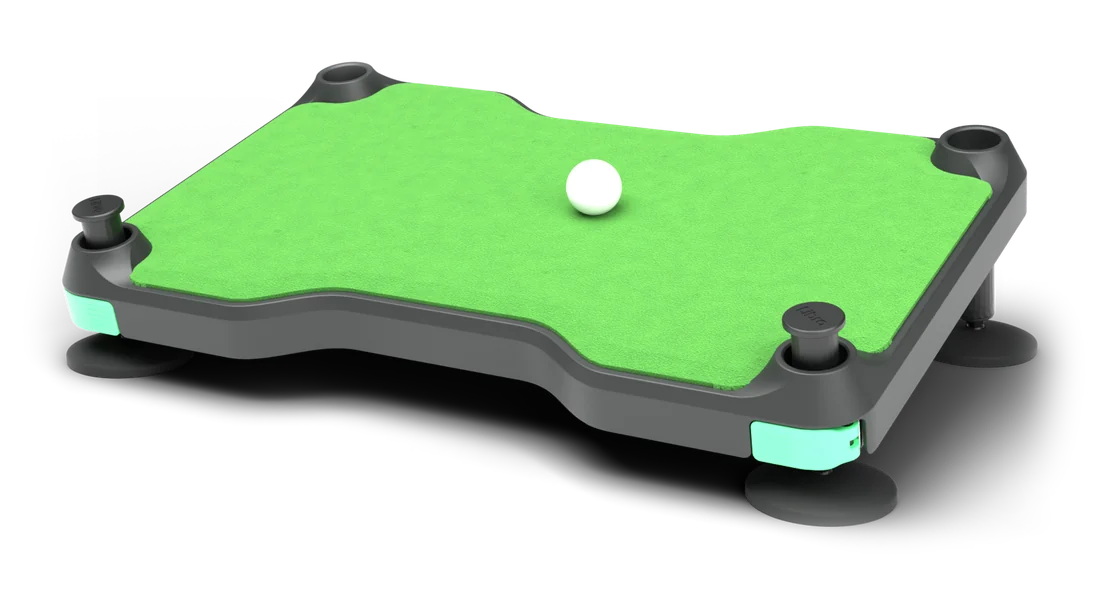
That last point is why we built Libro, a portable platform that tilts to recreate all four lies: up to 7 degrees uphill or downhill along its length and 13 degrees of sidehill across. A cam lock sets the lie in seconds, and engraved height lines let you set exactly the same lie again, so you can work through each slope and count your reps. There are no batteries and no subscription, and it works with any launch monitor or simulator. You can reserve one for £10, fully refundable, ahead of Kickstarter in early 2027.