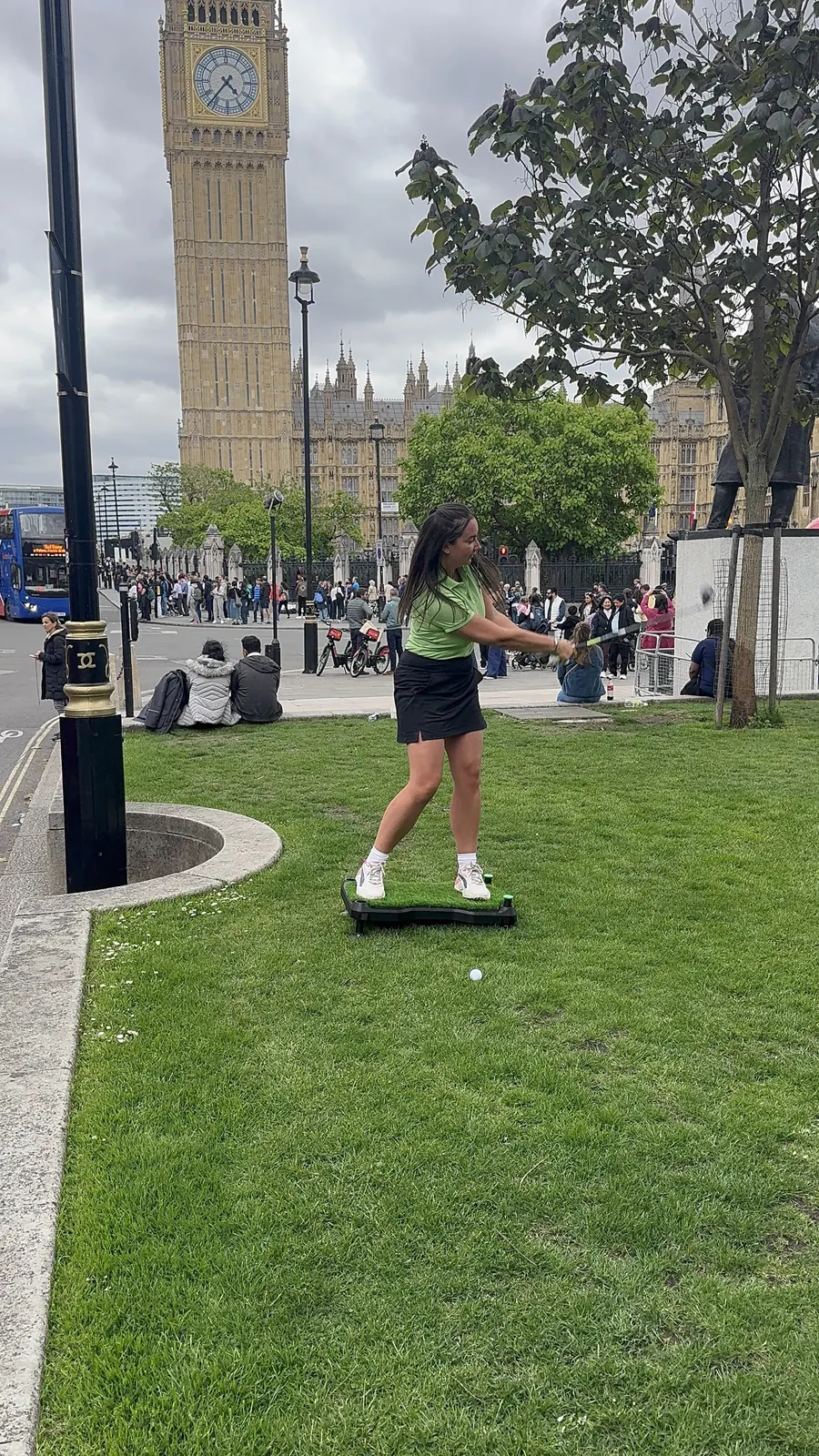
When the ball is below your feet, flex your knees more, bend further from the hips, widen your stance, hold the club at full length and aim left of the target. For a right-hander this lie sends the ball right, usually as a push or a fade. The biggest single key is staying down through impact, because standing up is what causes most of the bad shots from here.
This is the sidehill lie where the ground falls away from you towards the ball. You find it on the high side of a sloping fairway, on the top of banks, and on plenty of links holes. Ask a room of club golfers which lie they hate most and this one usually wins. It feels unstable, it makes you reach, and the miss can go a long way right.
You are not alone in finding it uncomfortable. When Celine Boutier faced the ball below her feet on the 16th at the 2026 Solheim Cup, commentator Kay Cockerill summed it up: "It's just an awkward stance." (GOLF.com)
Why it goes right
The geometry is the mirror image of the ball above your feet. With the ball lower, the toe of the club hangs down. A tilted face with loft on it points to the right of where the leading edge is aimed. So even a perfectly square strike can start right, and the more lofted the club, the stronger that effect.
Your body adds to it. With the ball below you, the swing becomes more upright and it is much harder to turn through freely. The hips get restricted, the arms struggle to release, and the face is often still open at impact. Many golfers who rarely slice will see a big fade from this lie.
The setup
Get down to the ball
The ball is further from your hands than normal, so you need to lower yourself. Flex your knees more than usual and tip forward a bit more from the hips. Hold the club at full length, right up to the end of the grip. On a steep slope you may feel like you are almost sitting.
Do not just bend over from the waist and reach with your arms. That puts you off balance and makes a top more likely.
Wider stance
A wider stance lowers you naturally and gives you a better base. It also restricts your turn a little, which helps you stay steady.
Weight back towards the heels
On this lie gravity pulls you forward, towards the ball and down the slope. Set a bit more weight towards your heels so you can stay balanced. If your practice swing finishes with you stumbling towards the ball, you need more weight back.
Ball position
Keep the ball around the middle of your stance for most irons. There is no need for a big change unless the lie is also tilted up or down the hill.
Aim left
Allow for the right tendency by aiming left. As with every slope, the amount depends on how steep it is and which club you hold. A wedge needs more aim left than a 6-iron. Aim the clubface on the line you want the ball to start, and set your feet, hips and shoulders parallel to it.
Choose a sensible club
Your swing will be shorter and more restricted from this lie, so you lose some distance. Many golfers take one more club and swing at around three-quarters. That combination gives you more control and better balance.
If the slope is steep and you have a long shot in, think twice about a long iron or fairway wood. They are hard enough to hit from a good lie, and from here they tend to come off the heel or the toe and fly well right. A hybrid or a mid-iron that gets you to a good spot for the next shot is often the smarter play. The post on sidehill lies with long irons explains why longer clubs magnify the problem.

The swing
Stay at the same height
Keep your knee flex and hip bend from address all the way through impact. The natural instinct on this lie is to stand up as you swing, and that pulls the club up away from the ball. The result is a thin or a top. Feel as if you stay down until the ball has gone.
Swing with your arms more than your legs
With your lower body more restricted, let your arms and shoulders do more of the work. Keep the leg action quiet and stable. This is one of the few lies where a slightly armsy swing is the right idea.
Short and balanced
A three-quarter swing at a smooth pace is plenty. If you can hold your finish without stepping towards the ball, you got it right. If you cannot, the swing was too big for the slope.
What goes wrong
Thin or topped. Standing up through impact, or setting up too tall.
Shank or heel strike. Falling towards the ball during the swing, so the hosel arrives first. More weight on the heels and a calmer swing help.
Slice well right. The expected miss. Aim further left, and make sure you are not also opening the face at address.
Pull left. Usually overcorrecting, swinging hard across the ball to stop the slice. Trust your aim instead.

When it comes with another slope
On a lot of courses the ball below your feet comes paired with a downhill or uphill slope. If the ground falls towards the target as well, both slopes push the ball right and both make it fly lower. That combination is covered in downhill with the ball below your feet.
If the ground rises towards the target, the uphill slope tends to send the ball left and partly cancels the push. Uphill with the ball below your feet explains how to work out which one wins.
Using the slope
If the flag is on the right side of the green, this lie can help you. Aim at the centre and let the slope move the ball towards the pin. Trying to hit a draw from here is a much harder shot, and most club golfers are better off playing the fade the lie gives them.
Quick answers
Why do I slice when the ball is below my feet? The tilt points the face right, and the more upright, restricted swing adds to it.
Should I bend my knees more with the ball below my feet? Yes. More knee flex and more hip bend, with the club held at full length.
Where should my weight be? A little more towards your heels, so you do not fall towards the ball.
Do you aim left or right? For a right-hander, aim left.
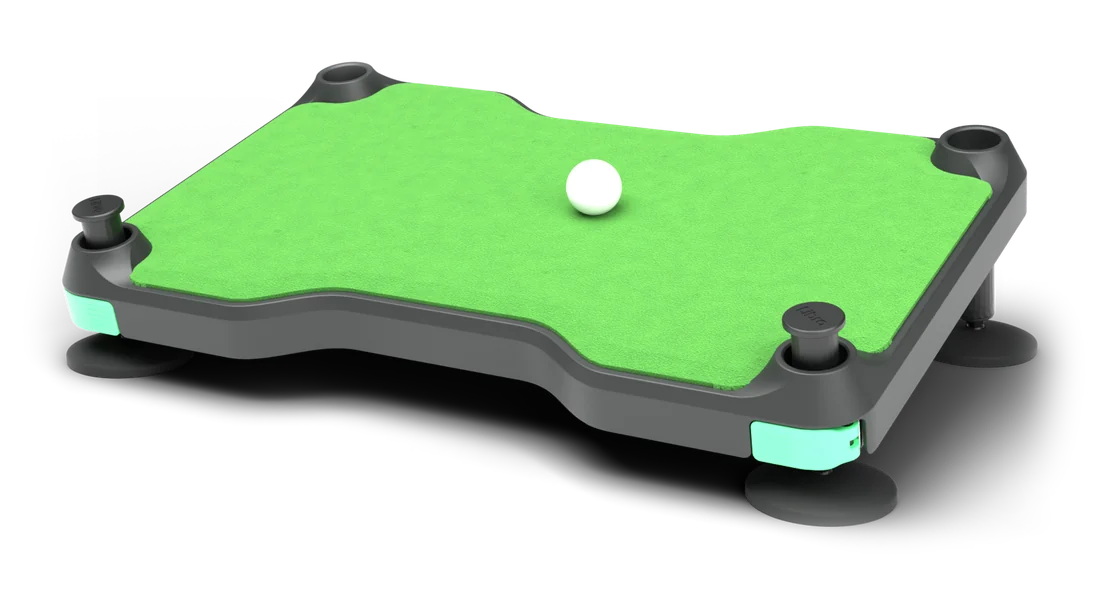
Ball-below-feet lies are almost impossible to find at a driving range, and on the course you get one attempt before moving on. Libro is a portable platform that tilts up to 13 degrees across, so you can stand above the ball at home and hit it until staying down feels normal. Set it with the cam lock, note the engraved height line, and set the same lie again next session. It is coming to Kickstarter in early 2027 and you can reserve one for £10, fully refundable.