
An uphill lie with the ball below your feet is one where the slopes fight each other. For a right-hander the upslope tends to send the ball left and the ball below your feet tends to send it right, so the two partly cancel and the shot can come out fairly straight. What does not cancel is distance. The upslope still adds height and the setup still restricts your swing, so take more club, start with your aim close to the target and adjust towards whichever slope is stronger.
You find this lie on a bank that rises towards the green but falls away from you towards the ball. It is common on the high side of fairways that climb up a hill, and on the upslope out of a hollow when you are standing on the higher side.
What each slope does
The upslope adds loft, so the ball flies higher and shorter. Your weight hangs back and your turn gets restricted, which tends to send the ball left. The full picture is in how to hit off an uphill lie.
The ball below your feet tilts the toe down, so the face points right. Your swing becomes more upright and your hips get locked up, which also pushes the ball right. That one is covered in ball below your feet.
So you have one effect pushing left and one pushing right. That is the good news.
Which one wins?
This is where you have to read the lie. There is no single answer, and anyone who tells you the shot will always go straight is guessing.
If the side slope is steeper than the upslope, the ball below your feet usually wins and the ball tends to go right. Expect a fade.
If the upslope is steeper, the uphill effect usually wins and the ball tends to go left. Expect a pull or a draw.
If they feel about equal, you can get a surprisingly straight shot.
The club makes a difference too. The sideways tilt of the face has more effect the more loft there is on the club, and the upslope is adding loft as well. With a wedge or short iron, the ball-below-feet push is likely to be stronger than you expect. With a 5-iron or hybrid, the uphill pull has more say.
A good way to read it is to stand at address and notice where your weight goes. If you feel mostly pulled towards your toes, the side slope is the bigger one. If you mostly feel your weight sitting on your back foot, the upslope is. The post on reading the slope of your lie has more on doing this quickly.
Setting up
Make the adjustment for each slope. Then check your balance.
For the upslope, tilt your shoulders so the lead shoulder is higher, roughly matching the ground, and play the ball a touch forward.
For the ball below your feet, flex your knees more, bend further from the hips and hold the club at full length. A slightly wider stance helps with both.
The tricky part is your weight. The upslope tips you back onto your trail foot, and the side slope tips you forward onto your toes. You end up pulled back and forward at the same time, in a sort of diagonal towards the ball and down the hill behind you. Set up with your weight a little towards your heels and braced on your trail leg, and keep the swing compact so you do not have to fight it.

Club choice
Take more club. On this combination nothing is giving distance back to you.
The upslope adds loft and costs carry. The ball-below-feet setup and the shorter swing you will make for balance cost some more. One extra club is the minimum, and on a reasonable slope two is often right. If the upslope is steep, the ball will also stop quickly when it lands, so you cannot rely on run to get it to the flag.
Aim
Start with your aim close to the target, then shade it towards whichever slope you think is stronger. If the side slope is bigger, aim a little left. If the upslope is bigger, aim a little right. If you honestly cannot tell, aim at the middle of the green and accept that the ball may move either way.
This is a good lie to think about where you can afford to miss. If there is water on one side of the green and a gentle bank on the other, set your line so either curve leaves you safe. How far to aim off on a sloping lie has some rough guides for the bigger slopes.

The swing
Smooth and slightly shorter than normal. You have taken extra club, so there is no need to go after it.
Stay down. The ball below your feet makes it tempting to stand up through impact, which leads to thin shots. Keep your knee flex until the ball has gone.
Swing up the slope. After impact, let the club follow the ground up the hill. Your finish will feel slightly higher and more on your back foot than normal, and on this lie that is fine.
What goes wrong
The most common miss is a thin shot from standing up, which with the upslope can also come up well short. Fat shots happen if the ball is too far back, because the ground in front of the ball is higher on an upslope.
Golfers who have read about the ball below their feet sometimes aim far left out of habit, then watch the uphill pull take the ball even further left. That is the real trap on this combination. Treat it as a different lie and aim accordingly.
Quick answers
Does an uphill lie cancel out the ball below your feet? Partly. The upslope tends to go left and the ball below your feet tends to go right, so they can offset. Which one wins depends on the slopes and the club.
Do I need more club? Yes. Usually one or two more, because both slopes cost you distance.
Where do I aim? Close to the target, shaded towards whichever slope is stronger.
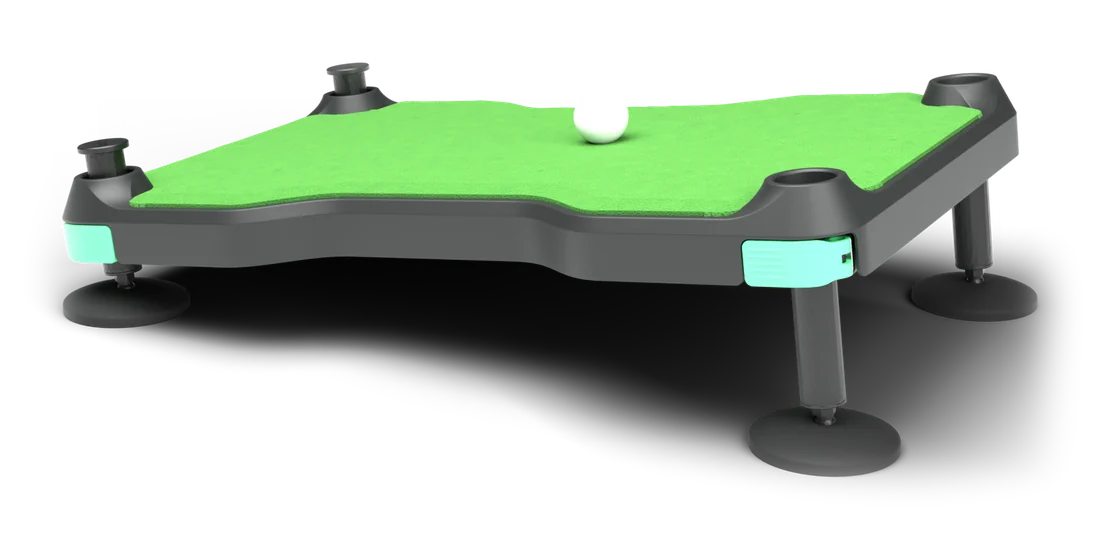
The only way to get a feel for which slope wins is to hit a lot of shots from different versions of it. Libro tilts up to 7 degrees along its length and 13 degrees across, and the engraved height lines mean you can set a particular lie, note it, and come back to exactly the same one later. Pair it with any launch monitor and you can see the start line and curve for yourself. It is coming to Kickstarter in early 2027, and you can reserve one for £10, fully refundable.