
To read the slope of your lie, use three checks in order: look at the ground as you walk up to the ball, feel which way your weight goes when you take your stance, and make a practice swing on the same slope. Only then choose the club and the target. Your eyes give you a first guess. Your feet give you the real answer.
It's worth doing properly because the slope decides the shot. A 7-iron from a flat lie and a 7-iron from a hanging lie are different shots with different clubs.
Start reading before you get to the ball
The best time to read a slope is on the walk. As you come towards your ball, take in the fairway around it as well as the spot where it's sitting.
A few things help:
- Look from the side. Walking up from the side of the hole, you can see whether the ground rises or falls towards the green. Straight on, slopes look flatter than they are.
- Look at the bigger shape. Is the ball on the side of a ridge? In a dip? On the down slope of a mound? Ground near the ball usually follows the bigger shape around it.
- Use the horizon or a tree line. If the fairway edge looks tilted against a level line in the distance, the ground probably is too.
- Notice where water would run. If rain would roll left to right across the ball, that's your sidehill tilt.
On links courses, the slope can change from one yard to the next, and the ball can sit on a tiny hump inside a bigger hollow. Look closely at the last few feet.
Then read it with your feet
Your eyes can fool you. Your feet rarely do.
Stand to the ball without a club, roughly in your stance, and notice where your weight goes.
| What you feel | What it means (for a right-hander) |
|---|---|
| Weight onto your back foot | Uphill lie |
| Weight onto your front foot | Downhill lie |
| Weight onto your toes | Ball below your feet |
| Weight onto your heels | Ball above your feet |
Often it's two at once. Weight back and onto your heels means uphill with the ball above your feet. Both effects matter, and the combined lies have their own guides, like uphill with the ball above your feet.
Also notice how much. If it's a gentle lean, you can play close to your normal shot. If you have to brace to stay balanced, it's a big slope, and it should change your plan as well as your setup.
Then a practice swing on the same slope
Make a practice swing next to the ball, on ground with the same tilt. Watch where the club brushes the grass and if you stayed balanced. That tells you where to put the ball in your stance, and whether to grip down, flex more, or swing softer. The full method is in using your practice swing to read a sloping lie.
Now decide what the ball will do
Once you've read the slope, say what you expect. For a right-hander, the usual patterns are uphill flies higher and shorter and tends left, downhill comes out lower, runs and tends right, ball above your feet tends left, and ball below tends right. The steeper the slope and the longer the club, the more of it you'll see.
The setup and swing changes for each lie are in the pillar guides. For a quick tour of all four, start at the four uneven lies explained.

Then pull the club
Here's the order that works:
- Yardage to the target.
- Adjust for the slope. Uphill usually means more club. Downhill usually means less, or the same club allowing for run.
- Adjust for what you can control. If the slope is steep or your balance is shaky, choose a club you can swing smoothly. Long irons and fairway woods are harder to control from slopes than short irons and hybrids.
- Adjust the aim for the curve you expect.
Steps 2 and 3 are where the course management happens. A steep downhill lie with 200 yards left is often a lay-up shot, even if the yardage says 3-wood. The lay up to a flat lie post makes that case.
Don't confuse the lie with the hole
One last thing. The slope under the ball is a different problem from the hole going uphill or downhill to the green. You can have a flat lie on a hole that plays steeply uphill, and a downhill lie on a hole where the green is above you.
The lie changes your setup, contact and curve. The elevation changes how far the ball needs to carry. Read both, separately, then combine them.
Practise the read
Reading slopes gets better with reps. If you only face slopes on the course, you'll only get a few chances per round to learn. Practising from a range of slopes, and saying what the ball will do before you hit, trains the read as well as the swing. Over time your feet get very quick at telling you what's going on.
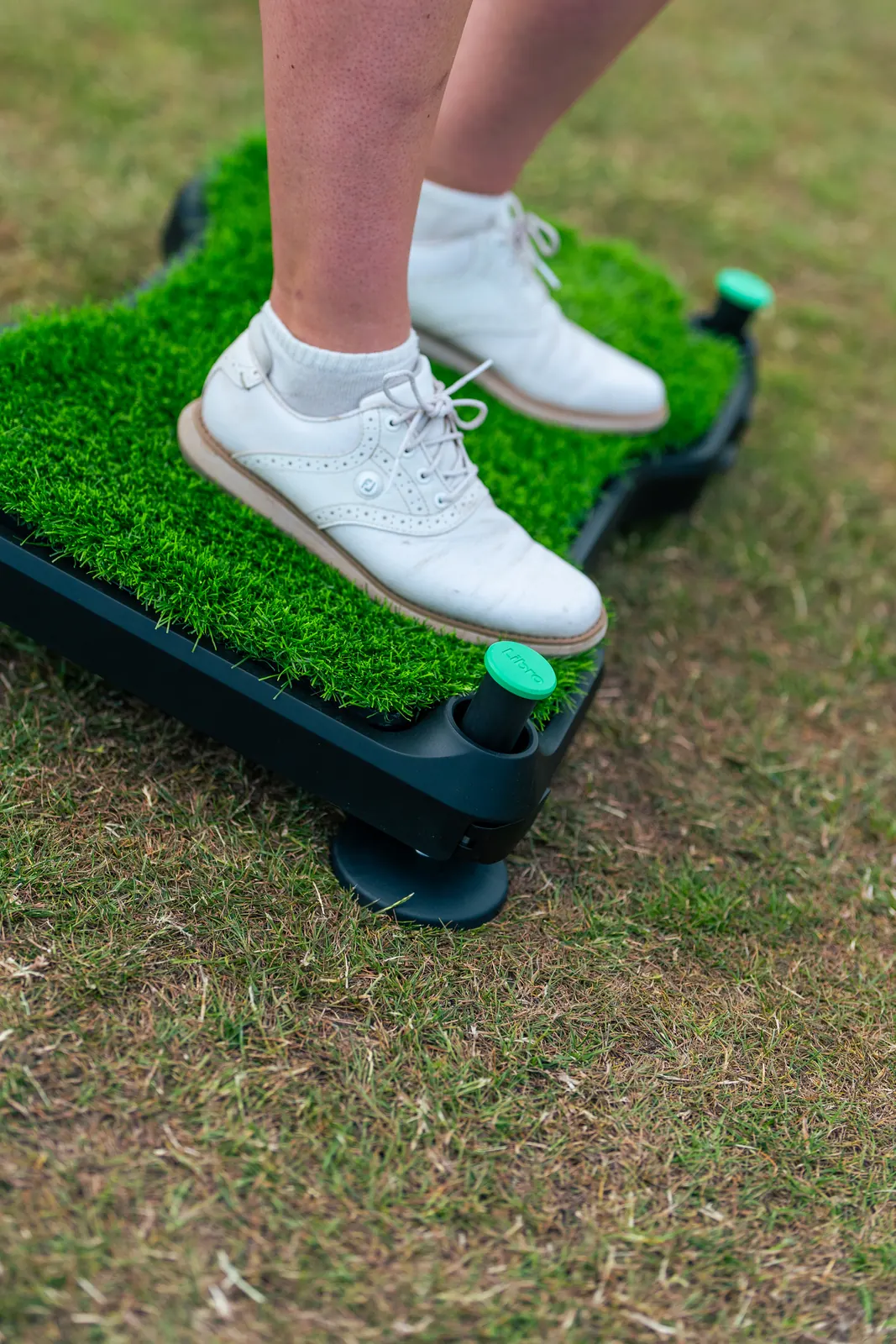
That's the idea behind Libro. It's a portable platform that tilts up to 7 degrees uphill or downhill and 13 degrees across, sets in seconds with a cam lock, and lets you feel a slope through your feet over and over. Feel what's real. You can reserve one for £10, fully refundable, ahead of the Kickstarter in early 2027.