
On a hilly course, the three things that cost club golfers shots are wrong clubbing on uphill and downhill holes, awkward lies on slopes, and tired legs on the back nine. Plan for all of them before you tee off. Expect to hit very few shots from flat ground, adjust your club for every big rise or drop, and pace yourself so your swing on the 16th looks like your swing on the 1st.
Clubbing up and down
The single biggest adjustment is distance. Uphill holes play longer than the number, downhill holes play shorter. As a rough starting point, many golfers add or take off about a yard for every yard of height difference, which for a lot of players works out at around a club for every 10 yards of rise or drop.
Treat that as a first guess. How high you hit it, how far your clubs go and how cold it is all change the answer. The uphill approach shots and downhill approach shots posts go into more detail.
On a new hilly course, the most useful thing you can do is pay attention on the first few holes. If you came up short twice going uphill, you know your adjustment needs to be bigger.
Tee shots: aim for the high side
When a fairway runs along the side of a hill, the ball will roll down toward the low side after it lands. On firm ground it can roll a long way.
So aim up the slope. A drive that lands on the high half of the fairway usually feeds back toward the middle. One that lands in the middle can run off into the rough on the low side, or further.
Think about what's below the fairway, too. If the low side has trees, out of bounds or a steep drop, give it even more room. If the high side is just thicker rough on a bank, missing there is often fine, because the ball tends to stay up on the bank instead of running away.
Expect sloping lies everywhere
On a hilly course, a flat lie is a bonus. Most of your approach shots will come from some kind of slope, and plenty will combine two at once, like a downhill lie with the ball below your feet.
You don't need to remember a list of rules on every shot. Two habits cover most of it. Take a practice swing on a similar slope next to the ball and notice where the club brushes the ground. Then swing within yourself, because a full, hard swing on a slope is the fastest way to lose your balance. The balance on uneven lies post explains why swinging at around 80 percent tends to work better.
If you want the setup for each lie, the four uneven lies overview walks through them.
Blind shots
Hilly courses love a blind tee shot or a blind approach over a ridge. A few things help:
- Look for the marker post or aiming stone, and pick the club that leaves you in the widest part of the landing area.
- If there's a bell or a periscope, use it. Hitting into a group you can't see is dangerous.
- Pick a precise target on the horizon, like a tree or a chimney, so you commit to a line.
- On a blind approach, remember the flag position from the board at the tee or from your app, and aim for the middle of the green unless you're sure.

Greens on hills
Greens on sloping ground often tilt with the land around them, though not always, because many are built up or cut in to make them playable. Look at the whole hillside from a distance as you walk up, since it's much easier to see the overall fall from 50 yards away than from on the green.
Being below the hole is usually the safer leave. Downhill putts on fast hillside greens can run well past.
Look after your legs
This bit gets forgotten. A hilly course is a long walk with a lot of climbing, and tired legs mean a shorter backswing, worse balance and lazy decisions.
- Use a trolley if you normally carry. Electric trolleys are worth their weight on steep courses.
- Walk at a steady pace up the hills instead of rushing to keep up.
- Drink water throughout, even on cool days. Eat something around the turn.
- Wear shoes with good grip. Worn spikes on a steep, damp bank are asking for a slip.
If your swing starts to feel rushed on the back nine, slow everything down and take an extra club. Swinging easy with more club is a good default when you're tired anyway.
Have a plan for the round
Before you play a hilly course for the first time, look at the course planner and mark the holes with big elevation changes. Decide which holes you'll club down on off the tee to stay on a flatter shelf. Note where the safe misses are.
On your home course you'll know all this already. The trick is writing it down, so you can practise the actual lies you face rather than just flat-lie shots on a mat.
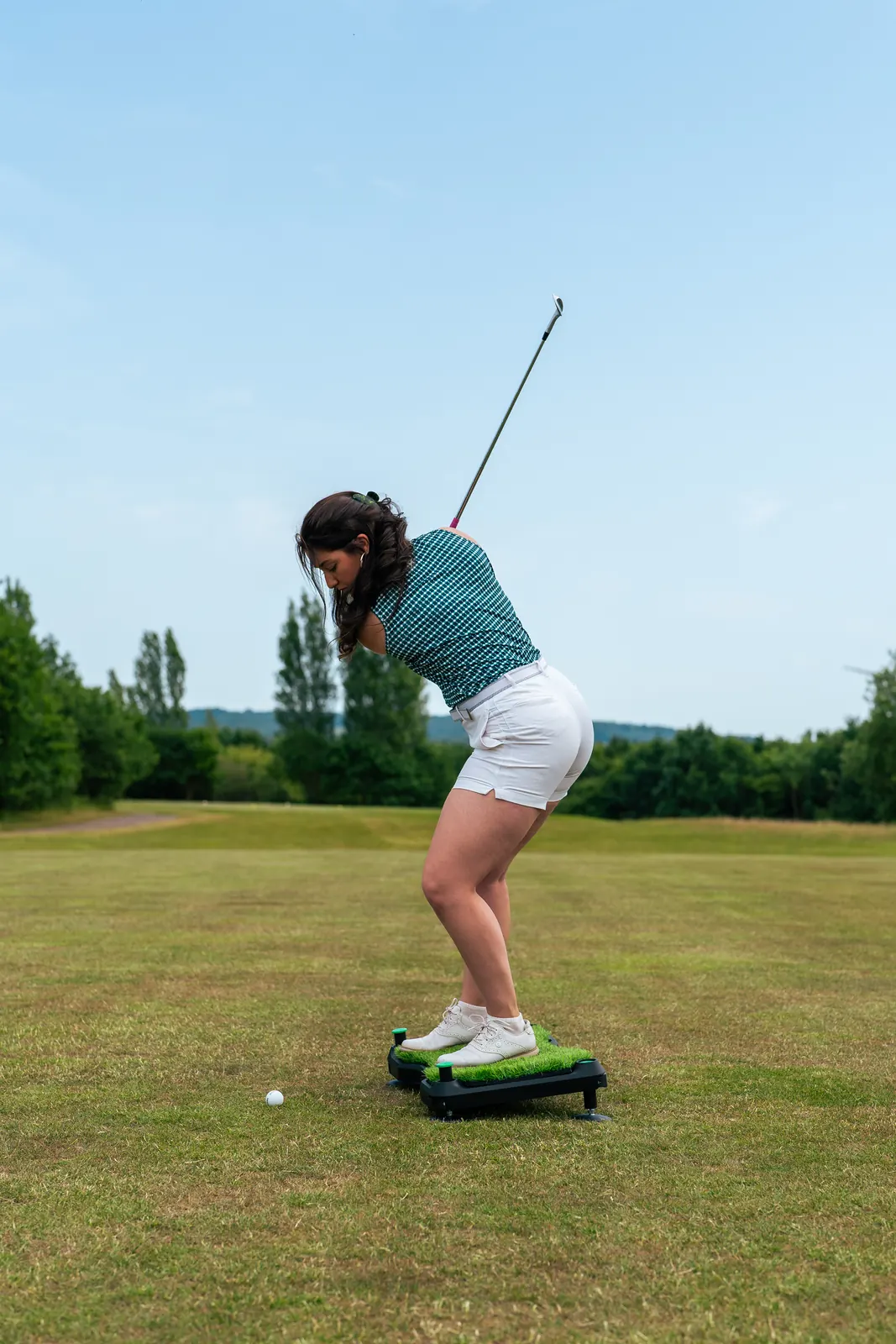
That's where Libro comes in. It's a portable platform you can set to an uphill, downhill or sidehill lie in seconds, up to 7 degrees along its length and 13 degrees across. It needs no batteries, and it's coming to Kickstarter in early 2027. You can reserve one for £10, fully refundable.