
When the green sits above you, the shot plays longer than the yardage. A common starting point is to add about one yard for every yard the green is above you, so a green 10 yards up plays roughly 10 yards longer. For a lot of club golfers that's about one extra club. Use it as a first guess and adjust from what your own shots tell you.
Uphill shot or uphill lie?
These get mixed up all the time, so it's worth being clear.
An uphill approach means the target is higher than you. You might be standing on perfectly flat ground. The extra club is about distance.
An uphill lie means the ground under your feet slopes up toward the target. The flag could be level with you or even below you. That changes your setup and the way the ball launches, and it's covered in the uphill lie post.
Very often you get both at once, which is where club golfers come up short. There's a whole post on elevation versus lie if you want to untangle them.
This post is about the first one: the green is above you, and you need to decide how much more club.

Why uphill shots play longer
Picture your normal 7-iron on flat ground. It climbs, peaks, and comes down to land at your usual carry distance.
Now raise the green 10 yards. The ball still follows roughly the same flight, but the ground "arrives" earlier. The ball hits the raised green before it's had a chance to come all the way down, so it carries less distance forward. You need a club that would fly further on the flat to land in the same spot up the hill.
The yard-for-a-yard rule roughly assumes your ball is coming down at around 45 degrees. That's why it works as a rough guide and also why it isn't exact for everyone.
When to add more, or less
The rule is a starting point. Several things move it.
How high you hit it. If your ball comes down steeply, it covers less ground on the way down, so a raised green steals less distance. High-ball hitters often need a touch less than the rule says. If you hit it low, the ball is coming in shallower and a raised green steals more, so add a bit extra.
How far you hit each club. The yardage gap between your clubs matters. If your irons are 10 yards apart, 10 yards of rise is one club. If they're 15 yards apart, it's less than a full club, and you might grip down on the longer one.
The weather. Cold, damp air and a wet ball cost carry. A big uphill shot in winter can need more than you'd think. Wind matters more higher up on exposed ground, too.
The miss. On most uphill approaches, short is the worst place to be. You're on a bank below the green, often with a tricky pitch up the slope and no view of the surface. If there's trouble behind, adjust, but on a typical raised green the longer club is the safer bet.
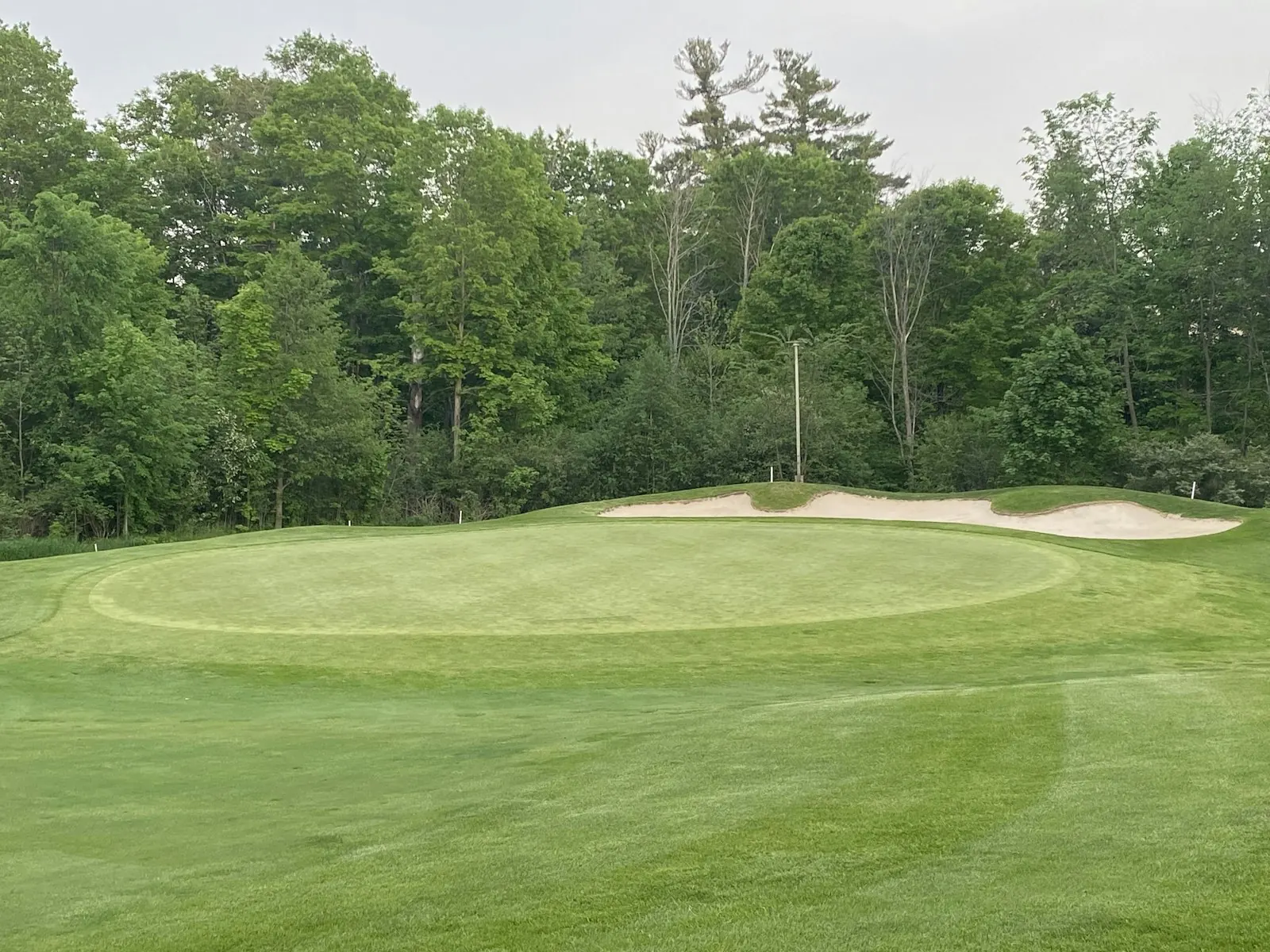
Judging how much higher the green is
The hardest part is knowing how many yards the green is actually above you. Some ways to estimate it:
- Compare to something you know. A person is about 2 yards tall. If the base of the flag looks about five people above your feet, that's roughly 10 yards.
- Use steps or flights of stairs. A typical storey of a house is about 3 metres. A green that looks two storeys up is around 6 metres, or roughly 6 or 7 yards.
- Course planners and yardage books. Some list elevation changes or give "plays like" yardages for big holes.
- Slope rangefinders. These calculate a "plays like" number. They're fine in casual play, but in most competitions the slope function has to be switched off. Check your club's local rules.
On your home course, learn the main uphill holes and write down what club worked. That's worth more than any formula.
Two things you can't see
When the green is above you, you often can't see the putting surface. That causes two problems.
First, you can't see the flag position properly, and it's easy to underestimate how far back the flag sits. Check the pin sheet or flag colour if your course uses them.
Second, you can't see slopes or false fronts on the green. Many raised greens have a bank at the front that kicks short balls back down the hill. Aim for the middle of the green and let the extra club do its job.
Swing your normal swing
The common mistake on uphill shots is taking the right club and then trying to hit it harder, because the green looks far away. You've already added the distance by clubbing up. A smooth, normal swing with the bigger club is what makes the adjustment work.
If you're also standing on an uphill lie, remember the ball will launch higher and fly shorter again, which is the classic double whammy. In that case you're adding distance for the lie as well as for the hill, so expect to be one or even two clubs more than the yardage on a steep hole. That's a starting point. Your first few attempts will tell you where it settles. If you find yourself going down the hill instead, the downhill approach shots post covers the reverse.
Learning how an uphill lie changes your carry is much easier if you can hit that lie again and again. Libro is a portable platform that tilts up to 7 degrees along its length for uphill or downhill lies, with laser-engraved height lines so you can set the same lie each session. It works with any launch monitor, so you can see the carry change for yourself.