
Most of the time, no. A downslope takes loft off the club, and a fairway wood does not have much to start with, so the ball tends to come out low, run along the ground and drift right for a right-hander. A hybrid, a more lofted wood or a mid-iron to a good spot is usually the smarter choice. There are times when the wood is the right club, though, and if you do take it, the setup below gives you the best chance.
It is one of the most common decisions club golfers get wrong. You are 230 yards out on a par 5, the ball is sitting nicely, and the 3-wood seems the obvious club. Then the slope does its work and you top it 60 yards along the fairway.
What the downslope does to a wood
With your shoulders tilted down the slope, as they should be, the club travels down and along the ground through impact. That takes loft off the face. A 3-wood starts behaving more like a 2-wood, or less, and most club golfers can barely get a 3-wood airborne from a flat lie.
The ground behind the ball is also higher than the ground in front. A long, flat-bottomed club like a wood has to come in at a shallow angle, and on a downslope there is very little room before it catches the turf behind the ball. Miss that window slightly late and you top it.
Add the general downhill tendencies, a push or fade to the right and a lot of run, and you can see why this is a low-percentage shot. The full picture for this slope is in how to hit off a downhill lie.
When the wood is worth it
There are situations where I would still take it.
- The slope is gentle and the ball is sitting up on decent grass.
- The ground in front of the green is open, with no bunkers or water to carry, so a low running ball is fine.
- The extra distance genuinely changes the next shot. Reaching the front of a par 5 in two, or leaving a short pitch instead of a long iron.
- You hit your fairway woods well from the flat. If they are a struggle from a perfect lie, a downslope will not help.
If all four are true, the wood can be a sensible play. If any of them are missing, look at the alternatives first.

The alternatives
Hybrid
A hybrid has more loft than a 3-wood and a shorter shaft, so it is easier to control and easier to get airborne. From a downslope it will still come out lower than normal, but it gives you a much bigger margin for error. Many golfers find a hybrid off a downslope goes nearly as far as their 3-wood would have, because the slope makes it run.
A more lofted wood
If you carry a 5-wood or 7-wood, this is where they earn their place. The extra loft helps counter what the slope takes away. A 5-wood from a downslope can fly more like a 3-wood from the flat, and it is far more forgiving.
Mid-iron to a flat spot
Sometimes the best choice is to give up on distance and play to a good position. A 7-iron to a flat area at a comfortable wedge yardage takes most of the risk out of the hole. It feels cautious. On a scorecard, it often comes out ahead of the 3-wood that went 60 yards. The case for this is made well in lay up to a flat lie.
If you take the wood
Set your shoulders with the slope, lead shoulder lower, so the line across them follows the ground. This is the key move. It puts the bottom of your swing where it needs to be.
Play the ball a little further back than your normal fairway wood position. Somewhere around the middle-forward part of your stance, rather than off the front heel, is a reasonable place to start on a moderate slope. Your practice swing will confirm it. Watch where the club first touches the grass and set the ball around there.
Put more weight on your front foot and keep it there. Widen your stance slightly for balance.
Aim a touch left to allow for the fade.
Swing down the slope. After impact, the club should chase down the hill, staying low for longer than usual. Keep your chest over the ball and resist the urge to lift up and help it into the air. That lift is what causes most topped shots from here.
Swing at about three-quarter pace. A clean strike with a smaller swing will go further than a full lash that catches the top of the ball.

Expect it to run
Even a good strike from this lie will come out lower than your normal 3-wood and run a long way. Plan for it. Pick a landing area short of where you want to finish and think about what the ball will meet when it lands. If there is a cross bunker or a ditch in range of that roll, the wood may not be the right club after all.
Thinking about it before you get there
The easiest way to avoid this shot is not to leave yourself in it. On holes you know, notice where the downslopes are and where the flat bits are. Sometimes a different club off the tee leaves you on a flatter part of the fairway with a much easier second. The post on course management when the fairway is not flat goes into that.
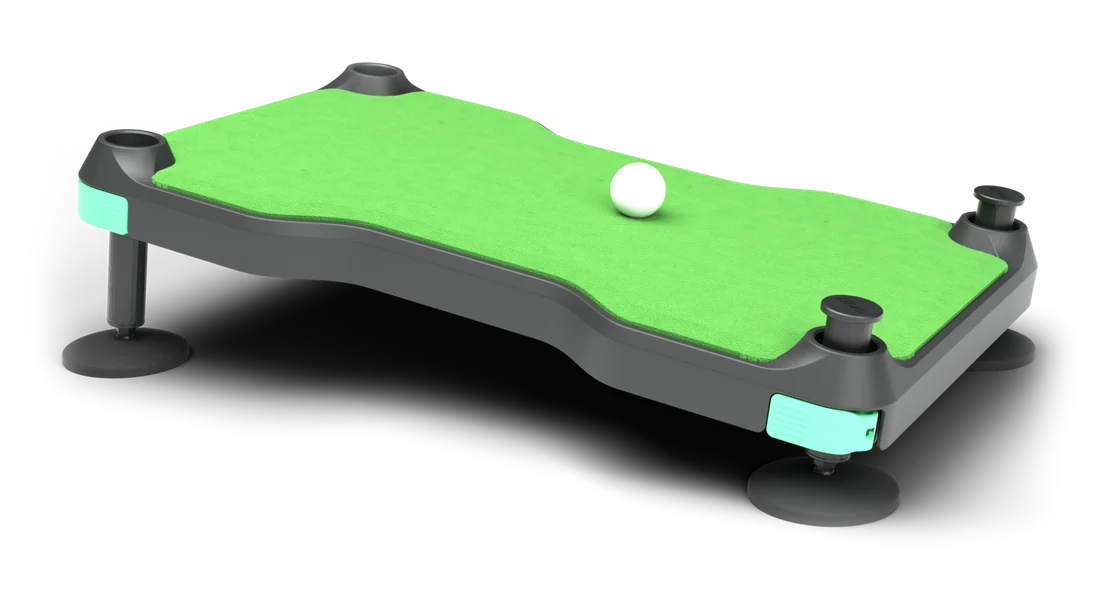
If you want to find out how your own woods and hybrids behave off a downslope, it helps to hit a lot of them with numbers in front of you. Libro is a portable platform that tilts up to 7 degrees along its length and works with any launch monitor or simulator, so you can compare a 3-wood, 5-wood and hybrid off the same slope and see the launch and curve for each. You can reserve one for £10, fully refundable, ahead of Kickstarter in early 2027.