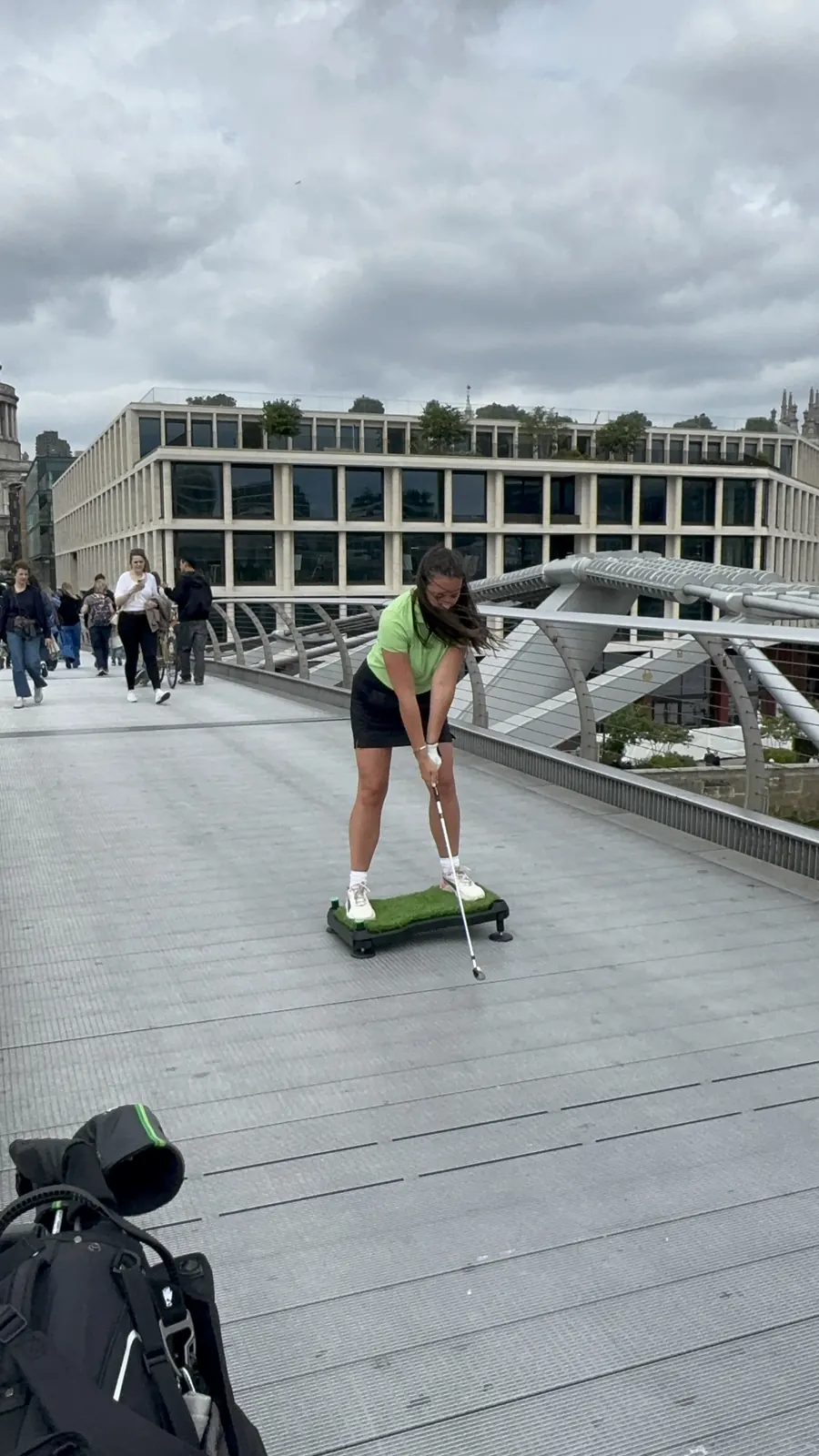
On a downhill lie with the ball above your feet, the two slopes partly cancel each other out. For a right-hander the downslope tends to send the ball right and the ball above your feet tends to send it left, so the curve is often smaller than you would expect. The flight does not cancel, though. The downslope still takes loft off, so the ball comes out low and runs. Grip down, tilt your shoulders down the slope, play the ball back and aim closer to the target than you would for either slope on its own.
This lie turns up when the ground falls towards the green and also rises towards the ball. You often get it on the low side of a fairway that runs downhill, or coming out of the back of a dip.
Two slopes pulling opposite ways
The downslope takes loft off the club, so the ball flies lower and runs further. Your weight is thrown onto your front foot and it is hard to release the club freely, which leaves the face a bit open and sends the ball right. For the full explanation, see how to hit off a downhill lie.
With the ball above your feet, the toe of the club points up, which aims the face left, and your swing becomes flatter. That sends the ball left. The full version is in ball above your feet.
So one slope says right, the other says left. In practice, the outcome depends on which slope is steeper and which club you are holding.
Reading which one wins
Here is how I would think about it standing over the ball.
Start with the club. The leftward tilt from the ball above your feet gets stronger with loft. A wedge with the toe up points noticeably left. A 5-iron with the toe up points left much less. But the downslope is also taking loft off, which weakens the leftward tilt a bit. So with a wedge, the ball-above-feet pull is still likely to win. With a mid or long iron, the downhill push often has more say.
Then look at the slopes. If you feel your weight being pulled back onto your heels more than forward onto your front foot, the side slope is the bigger one and the ball is more likely to go left. If the main feeling is of falling forward down the hill, the downslope is the stronger slope and the ball is more likely to go right.
If both feel about the same, you may well get a fairly straight shot. Do not count on it with total confidence, but do not aim miles off in either direction either.
Setting up
Combine the two sets of adjustments.
For the downslope, tilt your shoulders with the slope so the lead shoulder is lower. Put more weight on your front foot. Play the ball further back in your stance, because the low point of your swing moves back on a downslope.
For the ball above your feet, grip down on the club and stand a little taller. Keep some weight towards the balls of your feet so you do not fall back onto your heels.
The weight question is easier than on most combinations. The downslope pushes you forward and the ball above your feet pulls you back, so they balance each other to some degree. Most golfers find this one of the more stable sloping stances. The difficulty is in the strike.
How much to grip down depends on how far the ground rises to the ball. Enough that your posture feels like it does on the flat is the usual guide. Gripping down has more on getting this right.

Contact is the hard part
This lie gives you two different ways to hit it poorly.
The downslope makes the ground behind the ball higher than the ground in front. If the ball is too far forward, or your shoulders stay level, you will catch the turf behind the ball and hit it fat. If you lift up to help the ball into the air, you thin it.
The ball above your feet brings the ground closer to the club. If you do not grip down enough, the club hits the ground first and the ball comes out heavy.
So the checklist is short. Ball back, grip down, shoulders with the slope, and stay down through impact. Take a practice swing and watch where the club meets the grass. On this lie, that brush mark tells you more than any rule about ball position. If you thin it a lot from downslopes in general, why you thin it from downhill lies is worth reading.
Club and distance
The downslope takes loft off, so the ball comes out lower and runs more. Gripping down takes a bit of distance away. These partly offset, so a reasonable starting point is the club for the yardage, with an eye on the run.
If there is room in front of the green, plan to land short and let it roll. If you need to carry a bunker, think about more loft, because a low ball from this lie will not stop quickly.
Long clubs are still tricky. The downslope makes a fairway wood or long iron very hard to get airborne. A hybrid or mid-iron is usually the better option unless the slope is mild.

Aim and swing
Start with your aim near the target. Shade it right if you think the side slope will win, which is more likely with a short iron or wedge. Shade it left if you think the downslope will win, which is more likely with a longer club.
Make a compact, smooth swing. Let the club follow the slope down after impact, and let your swing be a touch flatter because the ball is above your feet. Hold your finish.
Quick answers
Does the ball go left or right from this lie? It depends. The two slopes partly cancel. A wedge will often go left. A longer iron will often go right.
Why does the ball come out so low? The downslope takes loft off the club. The sideways slope does nothing to give it back.
Do I need to grip down? Yes, by roughly as much as the ground rises towards the ball.
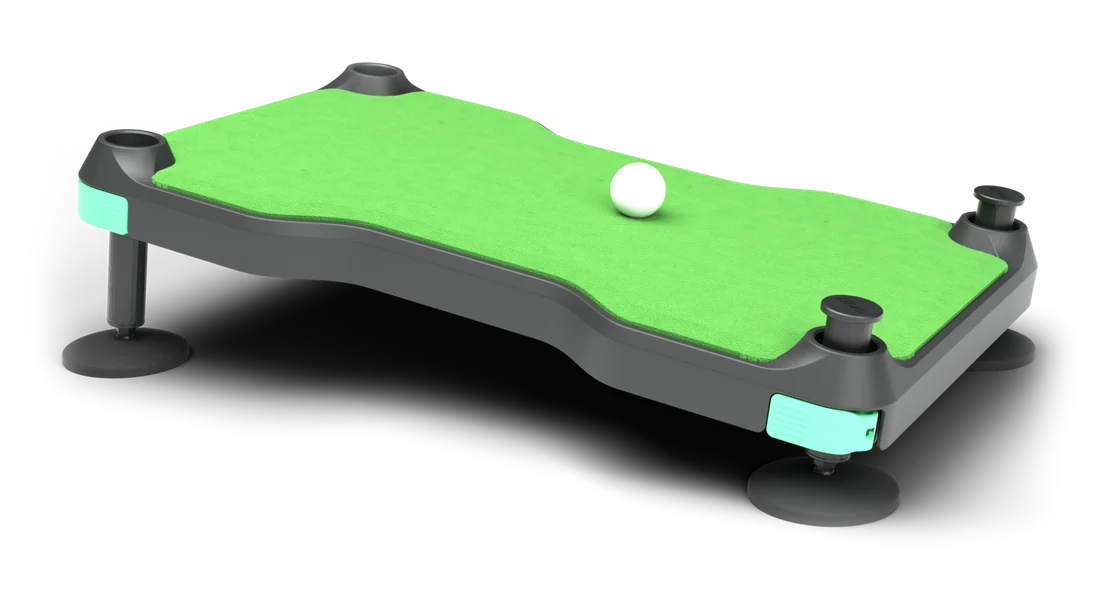
Learning which way this lie goes with your own swing needs reps, and a range mat will never give you them. Libro is a portable platform that tilts up to 7 degrees along its length and 13 degrees across, with laser-engraved height lines so you can set a lie, write it down and come back to it. It has no batteries and nothing to charge, and you can reserve one for £10, fully refundable, ahead of Kickstarter in early 2027.