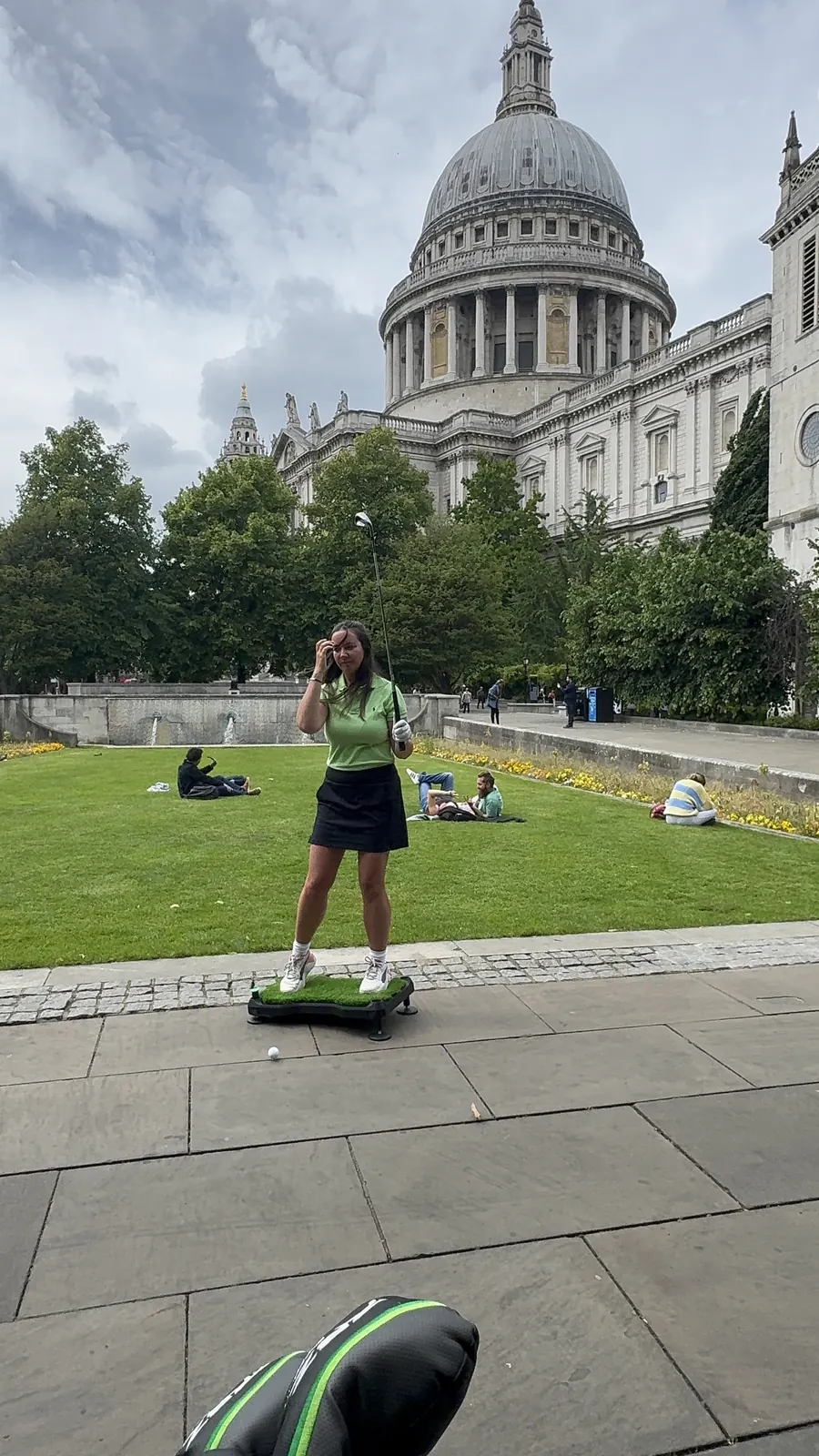
When the ball is above your feet, grip down on the club, stand a little taller, aim right of your target and make a flatter, more rounded swing. For a right-hander the ball wants to go left from this lie, and the more lofted the club, the further left it goes. Plan for the left miss instead of trying to fight it.
This is the sidehill lie where the ground rises towards the ball. You will find it whenever you are standing below the ball on a bank, often on the low side of a fairway that slopes across. Most golfers find it less frightening than the ball below their feet, because it feels more natural to swing around your body. It produces a very specific miss, though, and it catches people out again and again.
Why the ball goes left
Two things are going on at once.
The first is geometry. When the ball is above your feet, the toe of the club sits higher than the heel. Picture a wedge with its toe tilted up: the face, which points up to the sky because of its loft, now also points left. Even if your leading edge is aimed perfectly at the flag, the loft sends the ball left of it. This is why the effect is much stronger with a wedge than with a 4-iron. More loft, more tilt to the left.
The second is the swing. With the ball higher, you naturally swing on a flatter plane, more around your body like a baseball swing. A flatter swing tends to produce a right-to-left shape for most players, and it makes it easier for the hands to roll the face closed through impact.
Put them together and you get a pull, a draw or a hook depending on the slope and the club.
The setup
Grip down
The ball is closer to your hands than usual, so the club is effectively too long. Grip down the handle until your posture feels normal. On a gentle slope that might be an inch. On a steep one you could be down near the bottom of the grip.
If you skip this, the club will hit the ground before the ball. A heavy, pulled shot from this lie is very often a sign that the golfer did not grip down enough.
Stand taller
With the ground closer to your hands, you need less bend from the hips. Stand a little more upright. Your arms will swing more around you as a result, which is fine.
Weight towards the toes
On this lie gravity pulls you back towards your heels and away from the ball. Set a bit more weight on the balls of your feet so you stay balanced through the swing. If you feel yourself falling backwards on a practice swing, you need more weight forward on your toes.
Ball in the middle
Most coaches keep the ball around the middle of the stance on a sidehill lie, adjusted to the club. There is no need for big ball position changes unless the lie is also uphill or downhill.
Aim right
Aim to the right to allow for the ball going left. With a wedge you need more aim than with a mid-iron, because of the loft effect above. How much depends on the slope and the club, and the post on how far to aim off on a sloping lie gives some rough starting points. A common mistake is aiming right with your feet but leaving the clubface pointing at the flag. Aim the face where you want the ball to start, and set your body parallel to that line.
Club choice
Gripping down takes a little distance off. Many golfers also make a slightly shorter swing for balance. Between the two, you will often want one more club than the yardage suggests.
There is a useful trick here. Because less loft means less leftward tilt, a less lofted club swung easily goes straighter from this lie than a more lofted club swung hard. If you are between an 8 and a 9 with the ball well above your feet, the 8 gripped down and swung smoothly is often the better shot.

The swing
Let it be flatter. Your swing will want to go more around your body, and that is correct for this lie. Trying to force a normal upright plane usually makes contact worse.
Keep it balanced. A three-quarter swing at a steady pace is plenty. On a steep slope, think about holding your posture so you do not pull up or fall back.
Let the club release. Some golfers try to stop the ball going left by holding the face open. That tends to produce a block well right, or a weak slice. You have already aimed right. Trust it and make your normal release.
What goes wrong
The fat pull is the classic miss, nearly always from not gripping down enough or standing too close. The duck hook is the next most common, often from aiming at the target and swinging hard. A block right usually means you overcorrected with the hands.
Thin shots are rarer from this lie, but they happen if you grip down too far or stand up out of the shot.

When it gets combined
Ball above your feet rarely comes on its own. If the ground also rises towards the target, you have an uphill lie with the ball above your feet, and both slopes push the ball left. That one needs even more aim and more club, and it has its own post on uphill with the ball above your feet.
If the ground falls towards the target instead, the downhill slope tends to send the ball right and partly cancels the left tendency. See downhill with the ball above your feet for how to read which one wins.
Using it on purpose
Better players use this lie to play a draw without changing their swing much. If the flag is tucked left, a ball-above-feet lie can be a help, because the slope is already shaping the ball the way you want. Aim at the middle of the green and let it work towards the pin. It is worth knowing the slope can be an ally as well as a problem.
Quick answers
Why does the ball go left when it's above my feet? The tilt points the clubface left, and the flatter swing adds to it. Lofted clubs go further left.
How much should I grip down? Enough that your posture feels normal. Roughly as much as the ground rises towards your hands.
Should I take more club with the ball above my feet? Usually one more, because gripping down and a shorter swing both take distance off.
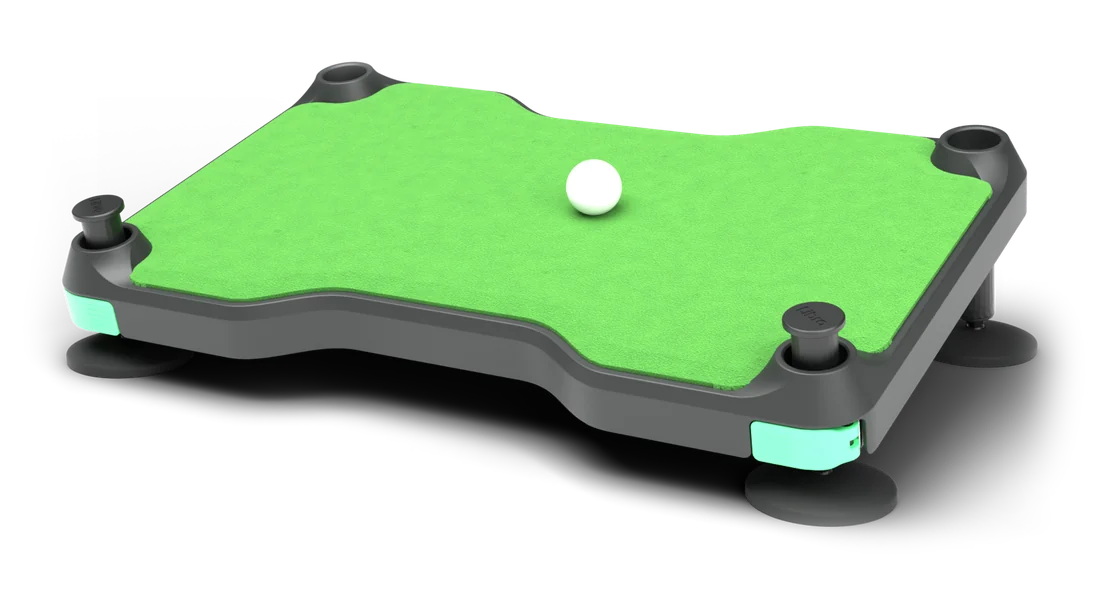
Sidehill lies are the hardest thing to rehearse at a range, where every mat is flat. Libro tilts up to 13 degrees across its width, so you can stand below the ball and hit shot after shot with a mid-iron and then a wedge, and see for yourself how much further left the wedge goes. It sets in seconds with a cam lock, works with any launch monitor or on its own, and you can reserve one for £10, fully refundable.