A wedge reacts to a sloping lie more than any other club in the bag. For a right-hander, the ball above your feet sends a wedge well left and the ball below your feet sends it well right, by more than the same slope would with a mid-iron. Uphill and downhill lies change the loft at impact, which changes how high the ball flies and how far it goes. Get those two ideas clear and wedge shots from slopes get a lot more predictable.
Most golfers learn their slope adjustments with a 7-iron in their heads, then carry the same adjustments over to a wedge. That is where a lot of wedges from 80 yards go wrong.
Why loft makes slopes matter more
On a sidehill lie the clubface is tilted. When the toe is up, the face points left. When the toe is down, it points right. The amount it points sideways depends on the loft. A 4-iron is fairly upright and barely changes direction when you tilt it. A 56-degree wedge lies back so far that tilting it points the face a long way off line.
You can see this for yourself at home. Hold a wedge with the leading edge square to a line on the floor, then tilt the toe up. Look at where the face is pointing. Now do the same with a mid-iron. The difference is obvious. If you want more of the mechanics behind it, why slopes change ball flight goes through them simply.
The uphill and downhill version works through loft directly. Tilting your shoulders with an upslope adds loft at impact. Tilting with a downslope takes it away. With a wedge, those changes have a large effect on how high and how far the ball goes, because you are often hitting partial shots where distance control is everything.

How each slope changes a wedge
| Lie | Direction (RH) | Flight and distance | First adjustment |
|---|---|---|---|
| Uphill | Slightly left | Higher, shorter, stops quickly | Take more club or swing longer |
| Downhill | Slightly right | Lower, runs out | Take less club or land it shorter |
| Ball above feet | Well left | Similar height | Grip down, aim right more than with an iron |
| Ball below feet | Well right | Similar height, harder to strike | Knee flex, aim left more than with an iron |
Uphill wedges
An upslope adds loft, so a pitching wedge starts flying more like a gap wedge, and a gap wedge more like a sand wedge. The ball goes up higher, comes down steeper and stops quickly. The usual miss is short.
There are two ways to deal with it. Take one more club, so a pitching wedge where you would normally hit a gap wedge, and make your usual swing. Or keep the club and swing a little longer. Most coaches favour taking more club, because making a familiar swing is easier to judge than adding an unfamiliar bit of length.
Set your shoulders roughly with the slope and play the ball a fraction further forward. On a steep upslope you will feel your weight on your back foot, and that is fine. Let the club swing up the hill after impact.
Downhill wedges
A downslope takes loft off, so the ball comes out lower and runs further. A sand wedge can fly more like a pitching wedge. The usual miss is long, often skidding through the back of the green.
Here many golfers use more loft than normal. If you would hit a gap wedge from the flat, a sand wedge from the downslope will often get you closer, because the slope brings its flight down to something like a gap wedge anyway. Then plan for the ball to run more than usual and land it shorter.
Shoulders down the slope, weight on the front foot, ball a bit further back. Stay down through the shot and let the club follow the slope downhill. Lifting up to help the ball in the air is the classic cause of a thin wedge that flies the green.

Sidehill wedges
With the ball above your feet, grip down and stand a little taller, then aim right. Further right than you would with an 8-iron from the same slope. The left tendency from the tilted face is at its strongest with a wedge, and this is the lie where good wedge players regularly pull shots into the left bunker.
With the ball below your feet, flex your knees, hold the club at full length and aim left. Again, more than you would with a mid-iron. Stay down, because standing up is the easiest way to thin a wedge from this lie.
For the full setup on both, see ball above your feet.
Distance control on slopes
On flat ground most decent golfers control wedge distance by swing length. Slopes add two complications.
The first is the loft change from uphill and downhill lies, covered above. The second is balance. It is harder to make a full, committed wedge swing on a slope without wobbling, so many golfers make a shorter swing than they would on the flat. That costs distance on its own.
A practical approach: on any slope, make a slightly shorter swing than normal and choose the club to suit. Accept that the full 100 percent wedge is not really available from a sloping lie, and plan with your 80 percent shot instead. If you know your three-quarter distances with each wedge, you will find these shots much easier.
Spin is harder to predict, and coaches do not all agree on it. What is easier to see is the landing. An uphill wedge comes down steeply and stops mainly because of that steep angle. A downhill wedge arrives lower and tends to release forward. The lie of the grass matters too, so watch your own shots and learn from them.
Short of a full wedge
Once you get inside a full wedge, around the green, the same principles apply but the shots change a little. Chipping has its own considerations, like whether to lean into an upslope or go with it. See chipping from an uphill lie and chipping from a downhill lie.
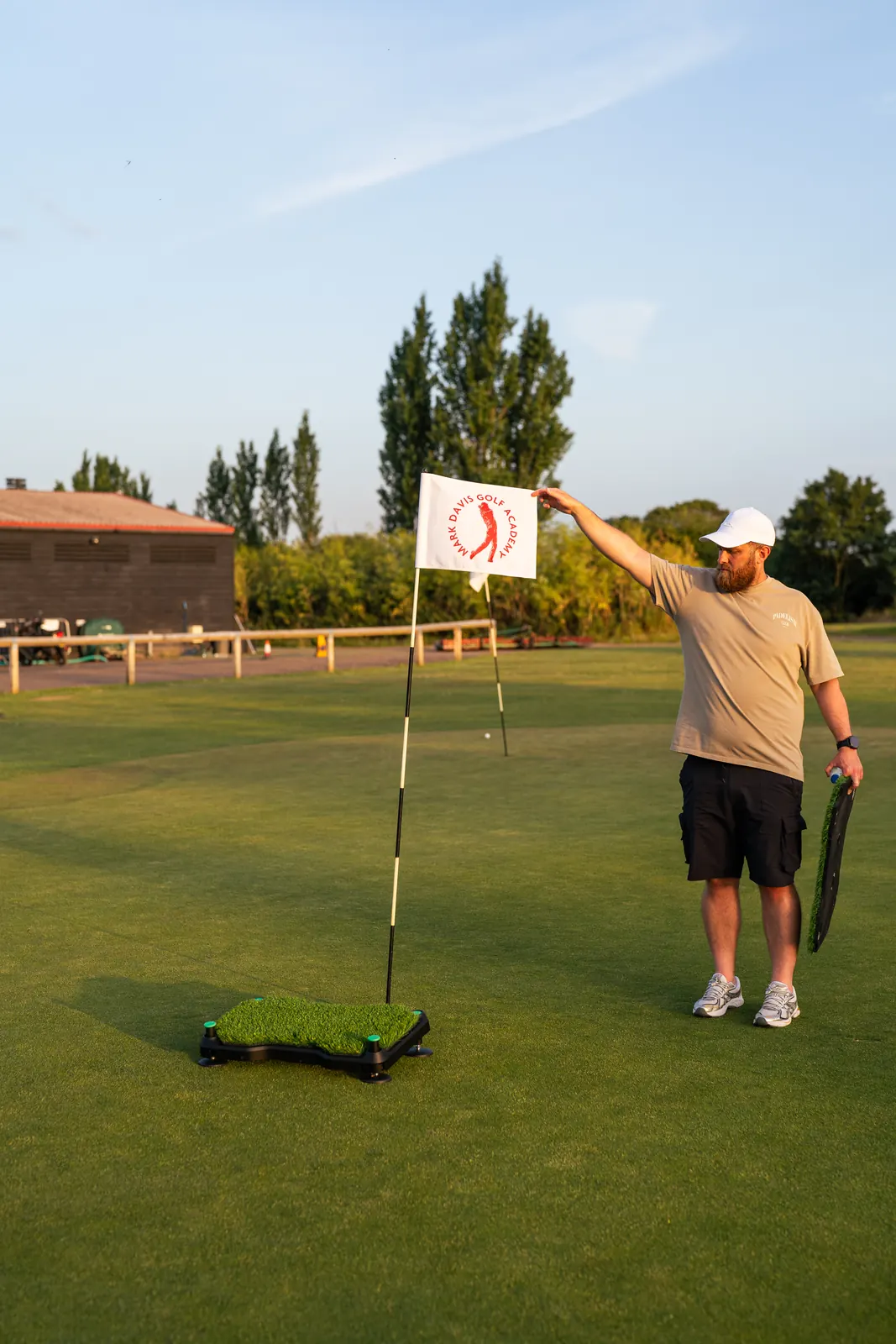
Wedges are the clubs where you most need real practice on real slopes, because the effect is so much bigger than with your irons. Libro tilts up to 7 degrees along its length and 13 degrees across, and the engraved height lines let you set the same lie each time and count reps on it. Hit a wedge and an 8-iron off the same sidehill setting and you will see the difference straight away. You can reserve one for £10, fully refundable.