
On a downhill lie, tilt your shoulders to match the slope, put more weight on your front foot, play the ball further back in your stance and aim a little left. For a right-hander the ball comes out lower than normal, runs further once it lands and tends to drift right. Then swing down the slope and stay with it until the ball has gone.
A downhill lie means your front foot (the left for a right-hander) is lower than your back foot. Most golfers rate it the harder of the two up-and-down slopes, and with good reason. The ground behind the ball is higher than the ground in front, so there is less room for error at the bottom of the swing, and the slope works against you when you want the ball in the air.
Why it is harder than an upslope
On an upslope the club naturally travels upwards into the ball. On a downslope it is the reverse. If you set up well, the club works down and along the slope, which takes loft off the face. A 7-iron starts flying more like a 6 or a 5: lower launch, less stopping power, more run.
The trouble comes when you set up as if the ground were flat. Your low point is then in the wrong place. The club either hits the higher ground behind the ball and goes fat, or catches the ball on the way up and thins it. Both feel awful and both are common. The post on why you thin it from downhill lies goes into the low-point problem in detail.
The rightward tendency is partly body and partly geometry. Your weight is pushed onto your front side, it is hard to release the club as freely as normal, and the face is often still a little open at impact. Most club golfers see a push or a fade that curves more than usual.
Even the best in the world find these awkward. After one off a downhill lie in the final round of the 2026 Masters, Rory McIlroy said: "I'm thanking my lucky stars with that one." (First Call Golf)
The setup, step by step
Shoulders with the slope
Tilt until your lead shoulder is lower than your trail shoulder and the line across your shoulders runs roughly parallel to the ground. This puts your swing's low point back where it belongs relative to the ball. If you only change one thing, change this.
Weight forward
Matching the slope moves your weight onto your front foot, and that is where it should stay. Many golfers feel as if they are about to topple down the hill. A slightly wider stance and a bit more flex in the front knee help you stay steady.
Ball back
Play the ball further back than normal, towards the higher foot, which on a downslope is your back foot. How far back depends on the slope. On a gentle one, perhaps a ball's width. On a steep one, it can sit well back of centre.
Use your practice swing to confirm it. Swing next to the ball and see where the club first brushes the grass. On a downslope that point is usually further back than you expect, and the ball should sit at or just behind it.
Aim left
Allow for the ball drifting right by aiming a little left. As with all slopes, the right amount depends on how steep it is and which club you have in your hand. Start small, see what happens, and adjust.
Which club to take
This is where coaches give slightly different answers, so here is the reasoning instead of a rule.
The slope takes loft off, so the ball flies lower and runs more. If there is room in front of the green, many coaches will tell you to take one club less than the yardage and let it run up. That works well on firm ground and open approaches.
If you need to carry something, like a bunker or water short of the green, a lower, running ball is the last thing you want. Then the sensible move is to keep the club you would normally hit, or even take more loft, so the ball can get high enough to clear the trouble. Accept it may finish a little long.
Long clubs are the real problem. With a 3-wood or long iron, the slope can take so much loft off that the ball never gets up. On a downslope, a hybrid or a more lofted wood is usually the better choice, and sometimes laying up is better still. Fairway woods from a downhill lie covers that decision.

Making the swing
Swing along the slope. The feeling most golfers describe is chasing the clubhead down the hill after impact, keeping it low to the ground for longer than usual. Your finish will be lower, shorter and more on your front foot.
Stay down. The instinct is to lift up to help the ball into the air, and that is exactly what causes the thin. Trust the loft on the club. Keep your chest over the ball until it has gone.
Swing at around 80 percent. Balance is harder on a downslope than almost anywhere else, and a smaller swing that stays in balance will make cleaner contact than a full one that wobbles. If you are falling forward at the finish, the swing was too big.
What tends to go wrong
- Thin or topped. Usually lifting up, or ball too far forward.
- Fat. The club hits the higher ground behind the ball. Ball probably too far forward, or shoulders level with the horizon.
- Push or slice right. The expected miss. Aim left more, and make sure the setup is not open.
- Too long. Forgot about the extra run. Club down or land it shorter.
- Pull left. Rare, and usually a sign of overcorrecting, swinging hard across the ball to stop the slice.

When the slope is severe
On a very steep downslope, the shot changes character. You may not be able to get a full swing in without falling over, and a long club becomes almost impossible to get airborne. In that case, take a mid or short iron, put the ball well back, make a three-quarter swing and aim to get back to a good position. A clean 140-yard shot from a steep downslope is a better result than a topped 3-wood.
A downhill lie with the ball below your feet is the toughest common combination, because both slopes push the ball right and both make it lower. That has its own post on downhill with the ball below your feet.
Quick answers
Do you aim left or right on a downhill lie? For a right-hander, aim a little left. The ball tends to go right.
Should the ball be forward or back on a downhill lie? Back, towards your back foot. How far depends on the slope.
Why do I top it off downhill lies? Usually lifting up through impact, or the ball sitting too far forward for the slope.
More or less club downhill? Often one less, because it runs. Keep the normal club or add loft if you need to carry trouble.
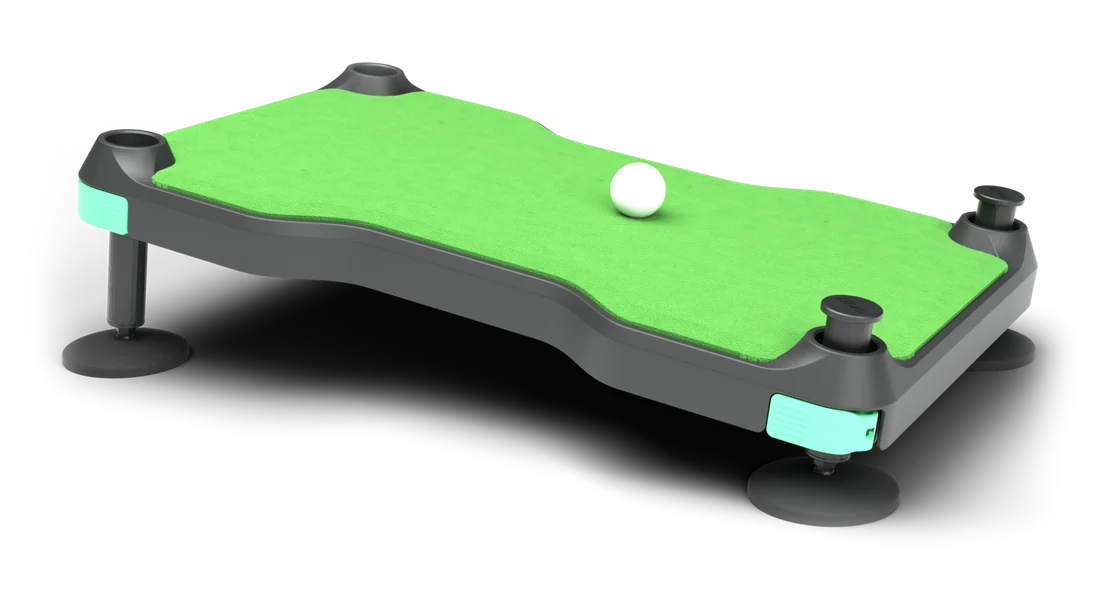
Downhill lies are hard to practise because you cannot easily find them on a range, and on the course you only get one go. Libro is a portable platform that tilts up to 7 degrees along its length, so you can set a downslope at home or in a sim bay and hit as many balls off it as you like. A cam lock sets the lie in seconds, and the engraved height lines let you come back to exactly the same slope and count your reps on it. It is coming to Kickstarter in early 2027, and you can reserve one for £10, fully refundable.