
Good course management on a sloping fairway starts before you hit the tee shot. You look at where the ball is likely to stop, pick the club that leaves you on the flattest ground you can reach, and accept a slightly longer approach if it comes from a better lie. Most club golfers plan for distance and line. Adding "what will I be standing on?" to that list saves shots without changing your swing at all.
Read the hole like a contour map
Stand on the tee and look past the flag stick or marker post. Ask where the ground is shaped rather than where the fairway is widest.
A few patterns repeat on almost every course:
- Tops of humps shed the ball. A drive that lands on a crest usually trickles off one side and stops on a slope.
- Hollows collect it. The bottom of a dip is often the flattest spot on the hole, which is why so many divots end up there.
- Fairways tilt toward the low side. If a hole runs along the side of a hill, balls drift down to the lower edge. The upper half of the fairway is often where you want to land, so the ball feeds back to the middle instead of off into the rough.
- The run-out zone matters more than the landing zone. On firm summer ground your ball may travel 20 or 30 yards after it pitches. Plan for where it stops.
A course planner or yardage app helps, but nothing beats a practice round where you walk the landing areas and stand on them. You'll notice slopes you never see from the tee.
Match the slope to your shot shape
This is the part most golfers never think about. For a right-hander, the ball above your feet tends to go left and the ball below your feet tends to go right. Your natural shape either fights that or piles on top of it.
| Your usual shape | Lie that helps | Lie that hurts |
|---|---|---|
| Fade or slice | Ball above your feet | Ball below your feet |
| Draw or hook | Ball below your feet | Ball above your feet |
So a slicer hitting into a fairway that tilts down to the left (which puts the ball above your feet) gets a lie that straightens them out. The same golfer landing on a fairway that tilts down to the right is going to see that slice get bigger. If you know which side of the fairway gives you which lie, you can favour the friendly side.
It won't always be possible, and it's a small edge. But small edges are what course management is.
Club down off the tee for a better lie
On a lot of holes the fairway is flat up to a certain point and then starts tumbling toward the green. Driver gets you past the shelf and onto the slope. A hybrid or long iron leaves you on the shelf, 30 yards further back.
Most club golfers will take the shorter approach every time. Think about what that approach actually looks like, though. A 9-iron from a hanging downhill lie, with the ball coming out low and running, to a green with a bunker in front. Against that, a 7-iron from a flat lie where you know your carry. For plenty of golfers the 7-iron is the better shot, and there's a full post on choosing to lay up to a flat lie.
The same thinking works on par 5s. Your second shot doesn't have to go as far as possible. It has to set up the third.

When you end up on a slope anyway
You will. Fairways aren't built flat, and even a perfect tee shot can bounce sideways. When you get there, two decisions come before the swing.
First, change the target. A sloping lie makes your miss bigger and less predictable, so aim at the fat part of the green and let the flag go. If a bunker guards the side the slope wants to send it, give that side extra room.
Second, pick the club for the lie, then adjust for the distance. Uphill lies tend to fly higher and shorter, downhill lies lower with more run. If you want the setup for each one, the four uneven lies explained post covers them in turn. Before you go there, take a minute to read the slope of your lie properly, because guessing how steep it is costs as many shots as the swing does.
Plan around the green as well
Course management doesn't stop at the approach. Missing the green on the low side usually leaves an uphill chip, which is the easier one for most club golfers. Missing on the high side leaves a downhill chip to a green running away from you, often from a tight lie.
If you're between clubs to a raised green with a steep bank in front and nothing behind, that's a clue to take the longer club. If the green sits below you and slopes away, being short and below the hole is usually the safer miss. Each course has its own version of this, and you learn it by paying attention.
Write your home course down
Most of us play the same course week after week, which means the same lies come up again and again. The 4th always leaves the ball above your feet if you find the left half. The 11th always gives you a downhill second. Note them on a card or in your phone. It turns vague local knowledge into a plan, and it tells you exactly what to practise. There's more on that in rehearsing your home course.
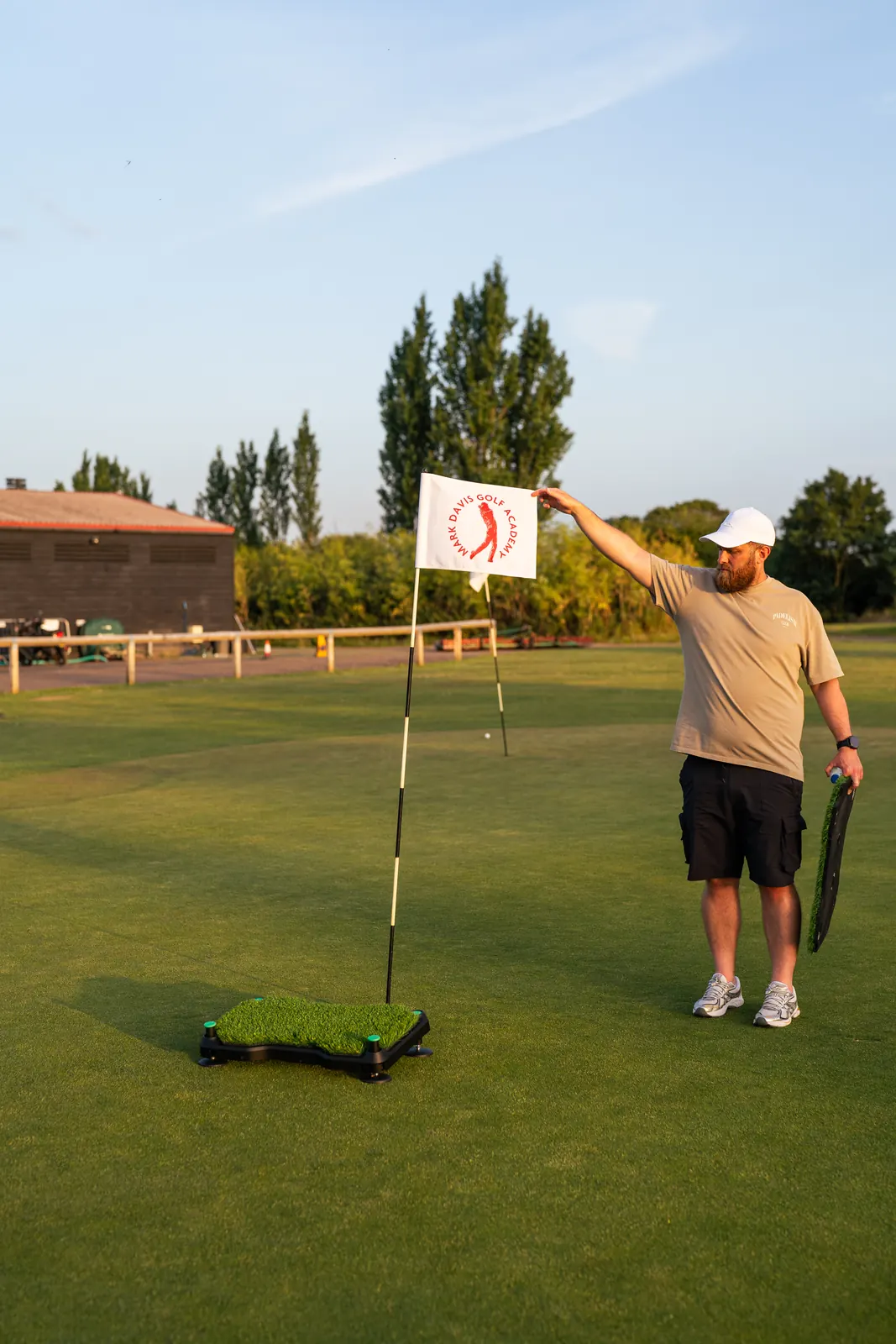
Once you know which lies your course keeps handing you, it makes sense to practise them on purpose. That's what Libro is for. It's a portable platform that tilts up to 7 degrees uphill or downhill and 13 degrees across for sidehill lies, and the laser-engraved height lines mean you can set the 4th-hole lie again next week and count your reps on it.