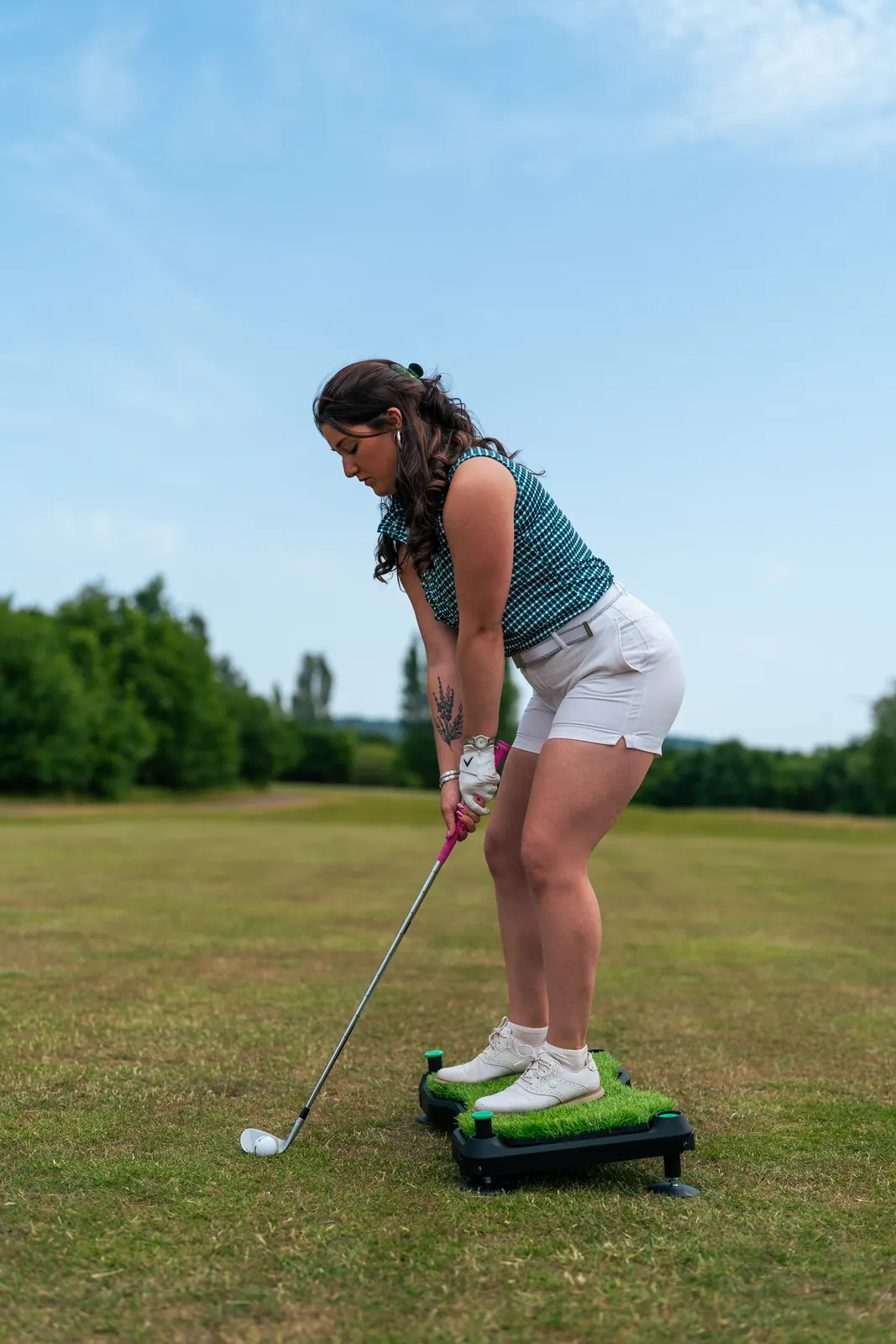
On a sloping lie, take a practice swing on the same slope as the ball and watch where the club brushes the grass. That spot tells you where the bottom of your swing is on this lie, so it tells you where to put the ball. The same swing also tells you if you need to grip down, flex your knees more, or swing softer to stay balanced.
It's one of the most useful habits in golf and most club players waste it on a quick wave at the air.
Why the low point moves on a slope
On flat ground, with a mid-iron, the bottom of your swing arc is usually a touch in front of the middle of your stance. You learn that without thinking about it, from thousands of shots on flat mats and fairways.
Tilt the ground and that changes. Your body leans with the slope, your weight shifts, and the bottom of the arc moves. On a downslope it tends to move back towards your trail foot. On an upslope it can move forward. When the ball is above or below your feet, the distance from you to the ground changes, so the club can dig in early or never reach the grass at all.
Your normal ball position is built for flat ground. The practice swing shows you where this lie wants it.

How to take a useful practice swing
Find a spot right next to the ball with the same slope. A couple of feet away is fine. A flat bit of ground nearby is no good, however tempting.
Set up as you plan to for the real shot: shoulders matched to the slope, the same grip-down, the same width of stance. Then make a swing at about the pace you intend to hit, and make it brush the grass.
Do it two or three times if you need to. Then look.
What to look for
Where the club touches the ground
This is the big one. Note the spot where the club brushed the grass, relative to your feet. For an iron, place the ball at that spot or very slightly behind it, so you catch the ball before the ground. If the brush mark is near your back foot, the ball goes back. If it's further forward than usual, move the ball forward a touch.
Mainstream teaching backs this up. Ball a bit further forward on uphill lies, a bit further back on downhill ones. The practice swing simply tells you how much for this particular slope, which no rule of thumb can.
How hard the club hit the ground
If the club bounced or dug well before the brush spot, you're too close to the ground. That usually happens with the ball above your feet. Grip down the handle until the practice swing brushes cleanly. The gripping down guide covers how far.
If the club barely touched, or skimmed over the top, you're too far from it. That's common when the ball is below your feet. Bend your knees a little more and stay in that posture through the swing.
If you stayed balanced
Did you finish standing up, or did you have to step to catch yourself? If you stumbled, the real swing will be worse, because you'll swing harder when there's a ball there.
Take some speed off and try again until you can hold the finish. Then take a bit more club to cover the lost distance. The balance on uneven lies post has more on this.
Which way the swing wants to go
You'll often feel the slope pulling the swing one way. With the ball above your feet the swing tends to feel flatter, more around you. Below your feet it feels more upright. You don't need to fight that. Just know it's why the ball tends to curve the way it does on those lies, and allow for it in your aim.

A short routine you can repeat
Here's a version that takes about ten seconds on the course:
- Same slope, next to the ball.
- Set up for the shot you plan to hit.
- Brush the grass once at real tempo.
- Look at the mark. Look at your feet.
- Adjust grip, knee flex or speed if needed, and brush again.
- Put the ball where the club brushed.
That's it. If you want to fold it into a full routine with reading the slope and picking a target, see the pre-shot routine for sloping lies.
What about the rules?
Practice swings are allowed, as long as you don't improve the conditions for your stroke. Under the Rules of Golf you can't, for example, knock down grass behind your ball or flatten the lie. Taking your practice swing a little away from the ball, on similar ground, keeps you clear of that and gives you the same information.
Practise it before you need it
Most golfers only take a slope practice swing on the course, and they're not sure what to make of it. Try this in practice. Take a practice swing on a slope, put the ball where the club brushed, hit it, and see if the strike was clean. Then try the ball an inch forward or back and compare. After a few sessions you'll trust what the practice swing tells you.
You need a repeatable slope to do that properly. Libro tilts up to 7 degrees along its length for uphill and downhill lies and 13 degrees across for sidehill ones, and the engraved height lines mean you can set the exact lie again tomorrow and compare. It weighs 4.97 kg and needs nothing to charge. You can reserve one for £10, fully refundable.