You can practise sloping lies at home without buying anything special. A bank in the garden, a plywood ramp, or a firm wedge under a hitting mat will all give you an uphill, downhill or sidehill stance. The catch is that most DIY setups only give you one angle, they're hard to make properly stable, and you can't easily set the same slope twice. They're a good way to start. Here's how to do each one safely and what to watch for.
Option 1: a slope in the garden
If your garden has a bank, you already have the best DIY slope there is. Real ground, and you can stand on it four ways to get uphill, downhill, ball above and ball below your feet.
Hitting real balls in a garden needs care. Use a good net, set up so a mishit can't reach a window, a neighbour or a person. Foam or limited-flight practice balls are a sensible start. Our guide to choosing a golf net for the garden covers size and placement.
If you can't hit balls, practice swings on the bank are still useful. Where the club brushes the grass tells you where to put the ball on that slope, which is the first thing to learn. There's a short guide to that in using your practice swing to read a sloping lie.
Keep your lawn in mind too. Repeated swings in one spot will chew it up quickly.
Option 2: a plywood ramp
The most common DIY build is a sheet of thick plywood on a frame of timber battens, raised at one end. Stand on it lengthways for uphill or downhill, side-on for a sidehill lie.
Things that matter if you build one:
- Thickness and support. Thin board flexes under a full swing. Use thick ply and support it underneath along its whole length as well as at the ends.
- Grip. Bare wood is slippery, especially in shoes. Fix a hitting mat or rubber matting to the top, firmly, so it can't slide.
- Stability. It must not rock, slide or tip. Test it with your full weight shifting hard onto each foot before you swing.
- Edges and corners. Sand or cover them. You'll be stepping on and off.
- Size. It needs room for both feet and the ball at the same slope. If only your feet are tilted and the ball sits on flat ground, you're not practising the real lie.
Build it strong. If you're not confident with tools, don't guess on this one.
Option 3: a wedge under a mat
Some people slide a firm wedge or a couple of boards under one edge of a mat. It's quick, but it's the least stable of the three. Mats can bend over the edge, and a soft wedge can compress or move under you. Use it for gentle angles only, and check it before every session.
How to measure the angle
You don't need anything fancy. For gentle slopes, every degree is about 1.75 cm of rise over a metre of length. So a board that's a metre long and raised 7 cm at one end is roughly 4 degrees. A spirit level and a tape measure will get you close enough.
Write the measurement down. If you want to practise the same lie next week, you'll want to know what it was.

Height changes everything
Raising your hitting surface brings your head and club closer to the ceiling. In a garage or spare room, check your clearance with a full swing on the ramp before you hit balls. If you use a launch monitor, the ball also sits higher than it would on the floor, so check the maker's guidance on placement.
The limits of DIY
- One angle per build. Changing the slope often means another ramp.
- Repeatability. Unless you've marked it carefully, you won't set exactly the same slope again.
- Combined lies. Uphill with the ball above your feet needs a surface tilted two ways at once. That's hard to build well.
- Wear. Timber, matting and fixings loosen over time. Keep checking.
- Safety. A homemade platform that shifts mid-swing can hurt you. Treat it like a step ladder: check it every time.
If a DIY ramp starts to feel limiting, our comparison of sloped golf mats vs tilting platforms looks at the shop-bought options.
Quick answers
What's the cheapest way to practise uneven lies? A slope in your garden or at the practice ground. Then a well-built plywood ramp.
How steep should a DIY slope be? Start gentle, a few degrees. You can always add more.
Can I use a DIY ramp with a simulator? Often, if the ball stays where the launch monitor can read it and your ceiling clearance is fine.
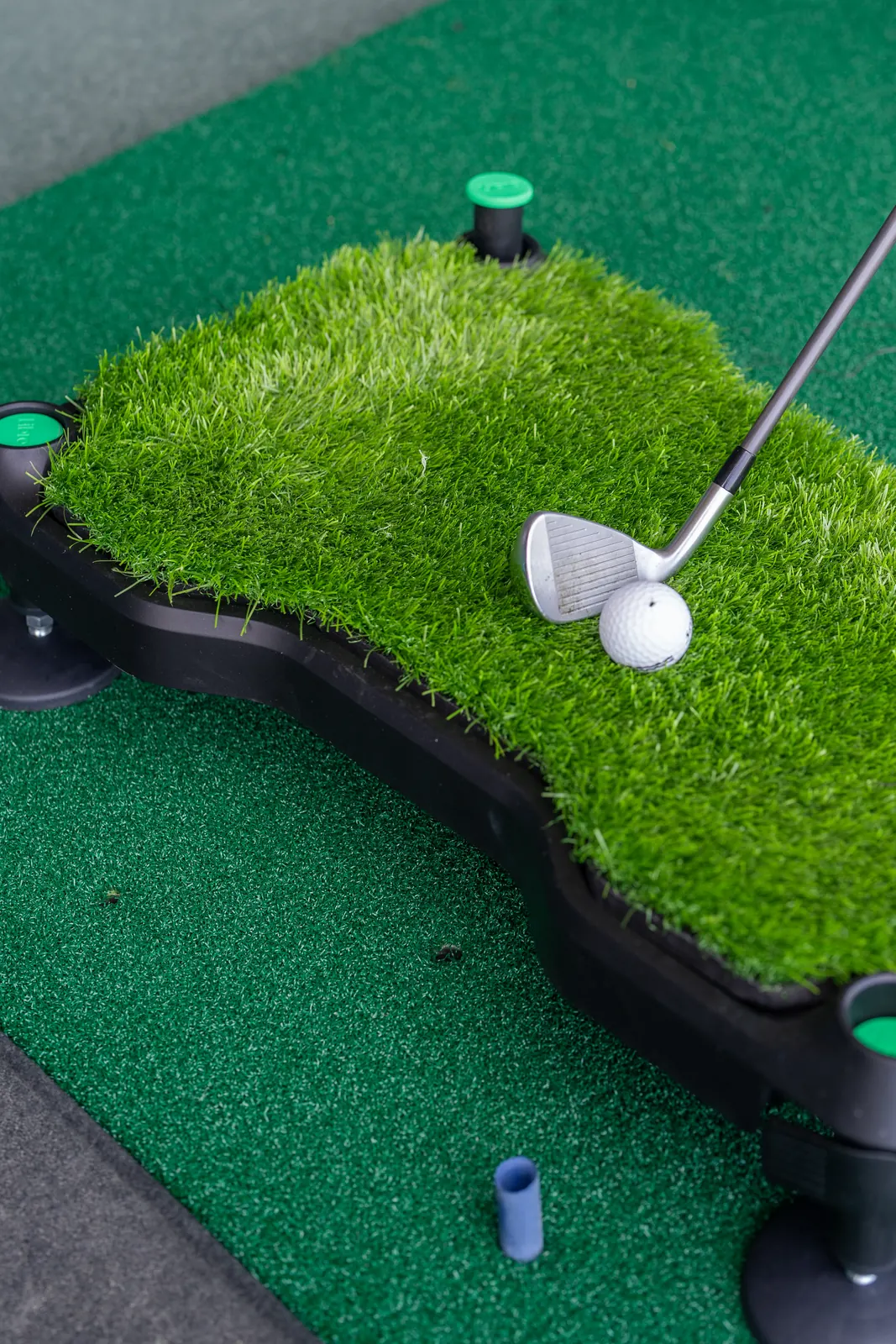
Libro is a portable platform aimed at the gaps a DIY ramp leaves. It tilts up to 7 degrees along its length and 13 degrees across, locks with a cam lock, and has laser-engraved height lines so you can set the same lie again. It's made from materials rated well beyond 250 kg and weighs 4.97 kg, so it moves easily between garden, garage and sim. Reserve one for £10 ahead of Kickstarter in early 2027.