The best golf practice equipment for home depends on where you're losing shots and how much space you have. For most club golfers, a putting mat and a pair of alignment sticks come first, because they're cheap and fit anywhere. With a garden or garage, a decent net and a good hitting mat come next. A launch monitor makes sense once you'll use it every week, and some way of practising slopes fills the gap nearly every home setup leaves. Buy in that order and you'll avoid the cupboard full of gadgets most golfers end up with.
Before you spend anything
Ask two questions.
Where am I losing shots? If it's three-putts, a launch monitor won't help much. If it's approach shots coming up short, a putting mat won't. Look at your last few scorecards and be honest.
Where will I actually practise? Living room, spare room, garage, garden. That decides what fits. Our post on golf practice in a small space has ideas for every size of room.
Putting
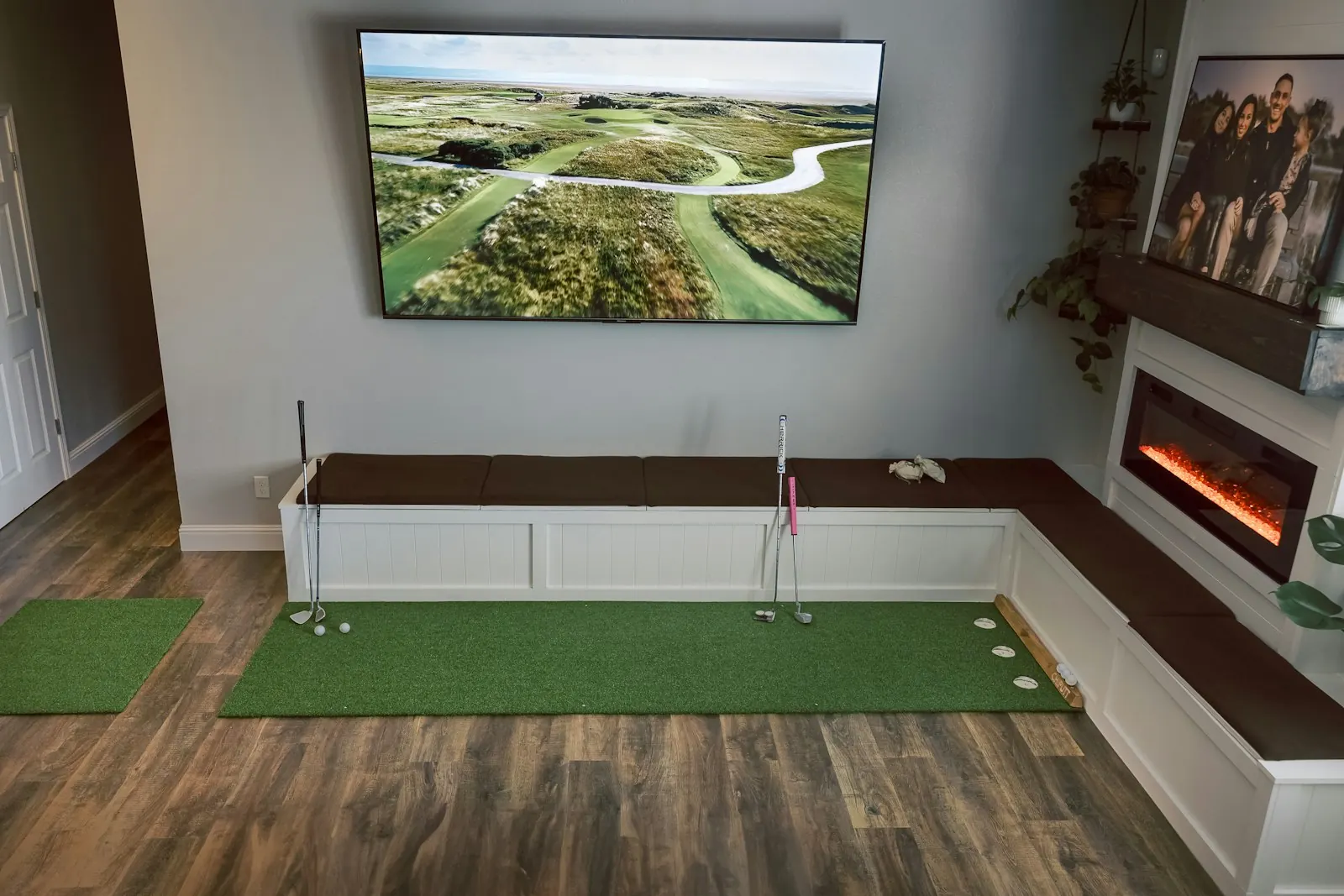
A putting mat is the most-used piece of home kit for a lot of golfers, because you can roll a few putts while the kettle boils. What to look for:
- Long enough to hit putts from at least six or seven feet.
- A true, flat roll with no ridges from where it was rolled up.
- A speed that's not wildly faster or slower than your club's greens.
A simple putting mirror or a gate made from two tees helps with start line. That's most of what putting comes down to from short range.
Chipping
A chipping net or target basket lets you practise short pitches into a target indoors or out. Foam balls make it safer in a house. It won't teach you how the ball reacts on a green, but it does help with strike and landing a ball on a spot.
Full-swing kit
Net
If you have a garden or garage, a net lets you hit real balls. Size, frame strength and the netting itself matter a lot more than the brand. We go through what to look for in choosing a golf net for the garden.
Hitting mat
The mat you hit off matters as much as the net. A thin, hard mat hides heavy shots and can hurt your joints. A thicker, better mat gives more honest feedback. See our guide to choosing a golf hitting mat.
Launch monitor
Turns a net into a proper practice station by showing carry distance, start line and curve. Prices and features vary enormously. Get one when you know you'll use it regularly, and when you've worked out where it'll sit in your space. If you're going the whole way to a sim, read home golf simulator setup first.
Swing feedback
Alignment sticks. Cheap and endlessly useful. Aim, ball position, swing plane checks, gate drills.
A mirror. Great for posture, grip and setup checks, especially in a room where you can't swing fully.
Phone and a cheap tripod. Film your swing from face-on and down the line. It's the most honest coach you'll find for free.
Strike spray. Shows where you're hitting the face. Pair it with a net and it's a quick way to find out whether your misses are heel or toe.
Fitness and speed
Resistance bands, a medicine ball and speed-training sticks are popular. They can help, especially for mobility and speed, but they're easy to overdo. If you have any back or joint history, check with a physio before adding speed work.
Slope practice
Most home setups miss this completely. Every piece of kit above is used on flat ground. On the course, plenty of your shots come with the ball above or below your feet, or one foot higher than the other.
Options range from free to very expensive:
| Option | Rough idea of cost | Variety of lies |
|---|---|---|
| Garden bank | Free | Four directions, one angle |
| DIY ramp | Low | Usually one |
| Fixed sloped mat | Low | One or a few |
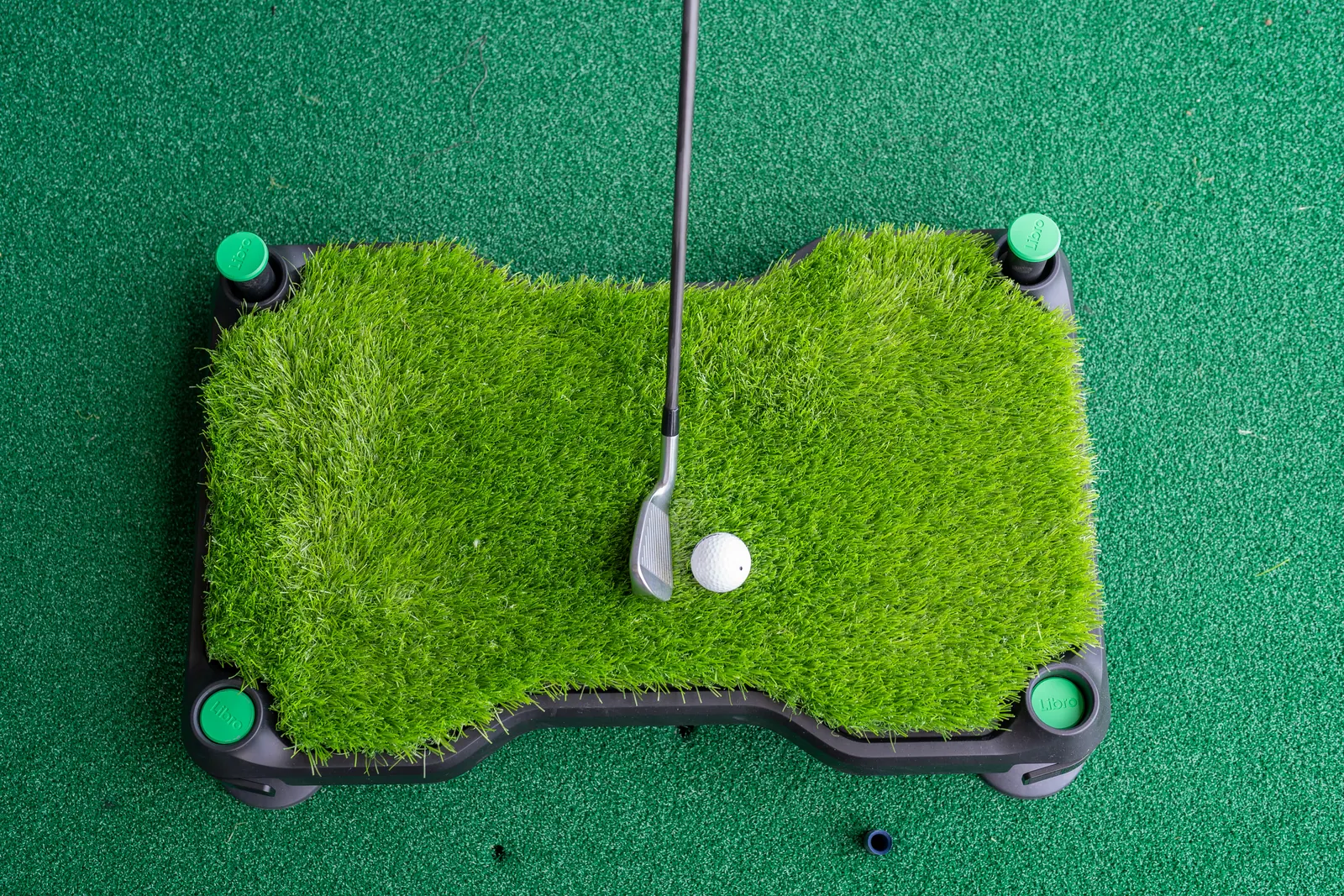
| Tilting platform | More than a fixed mat | Many |
| Motorised stage | £20,000 and up | Many |
A sensible order to buy in
- Alignment sticks and strike spray.
- A putting mat.
- A net and a good hitting mat, if you have the space.
- Some way to practise slopes.
- A launch monitor, once you're practising most weeks.
Some people swap 4 and 5. Either works.
What to skip
Gadgets that promise to fix your swing in a week. Anything that only clips to the club and does one thing you could do with an alignment stick. Kit that needs more space than you've got. If you can't leave it set up, you'll use it far less than you think.
Libro is a portable tilting platform for the slope part of that list. It sets uphill, downhill and sidehill lies up to 7 degrees along its length and 13 degrees across, needs no batteries or subscription, and works with any launch monitor or simulator, or on its own with a net. It comes to Kickstarter in early 2027. Reserve one for £10, fully refundable.