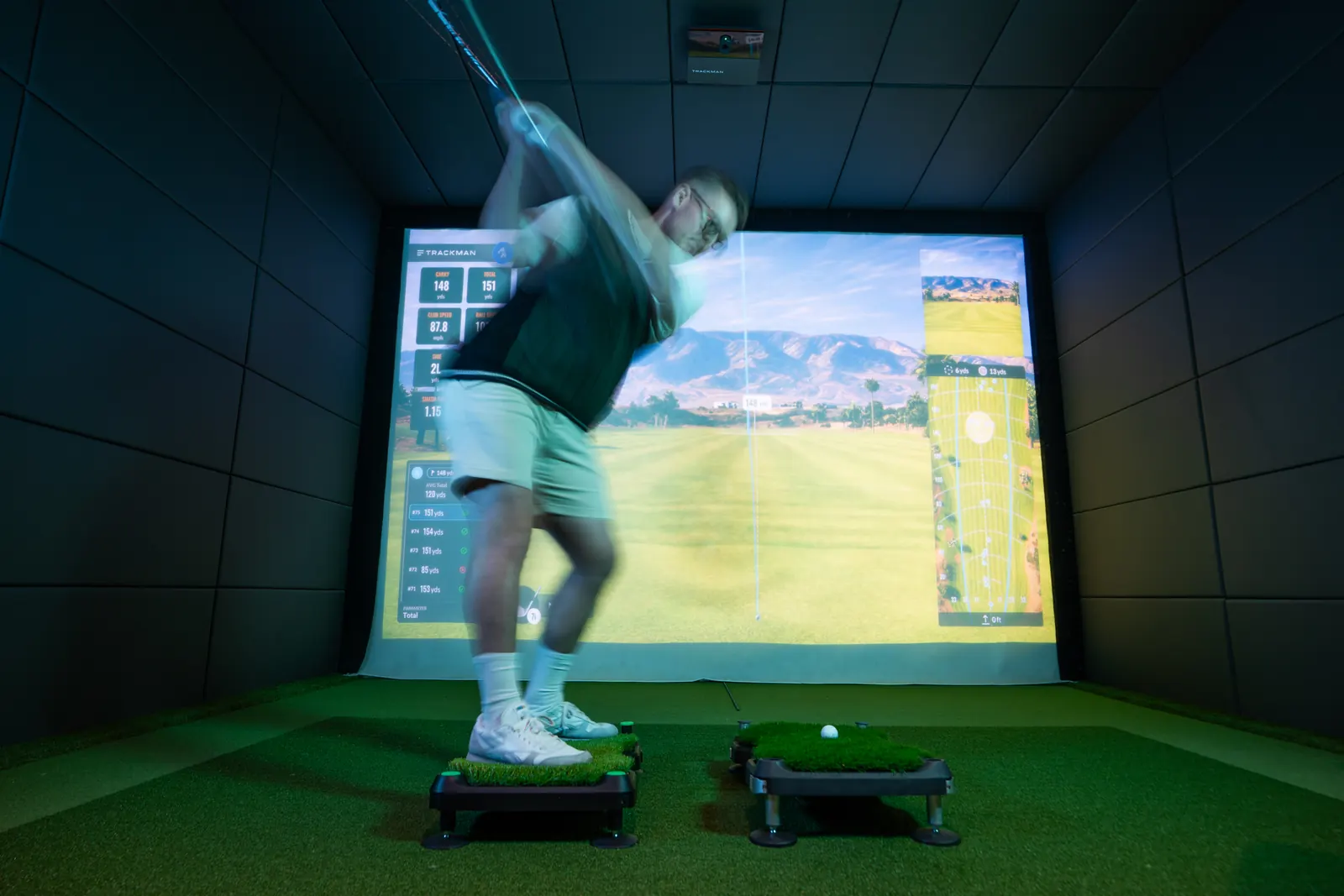
A motorised swing platform is worth £20,000 or more if you run a teaching studio, a fitting bay or a high-end sim venue where lots of golfers will use it every week. For a single home golfer, it's very hard to justify on cost alone, and most of the benefit (practising real slopes) can be had for far less. That said, nothing beats changing the lie in a moment without stepping off, so if money and space aren't a concern, it's the most convenient way to do it.
What a motorised platform is
A powered floor section that you stand on to hit. A motor tilts it to set an uphill, downhill or sidehill lie, and then back to flat. It's often set into the floor of a simulator room, so the hitting surface stays level with the surrounding floor when it's flat.
The best-known example is the Zen Green Stage, at around £23,795 + VAT. Other motorised stages exist too. All of them sit firmly at the top of the market.

Who they make sense for
Teaching pros and academies. A coach can put a pupil on a downhill lie, hit five balls, then change to ball above the feet, all without stopping the lesson. Over hundreds of lessons a year, the cost spreads out.
Club fitters. Fitters can see how a player's numbers change on a slope, which is closer to how the club will be used on the course.
Commercial sim venues. A premium bay that offers sloping lies stands out from a row of flat ones.
Serious home builds with the budget. If you're already spending a lot on a dedicated sim room and want the best of everything, it fits.
What to weigh up before buying
Cost
The headline price is only part of it. Depending on the model and your room, think about delivery, installation, any floor work needed to set it in, electrical work, and servicing over the years. Get a full quote, in writing, before you get excited.
Space and installation
A platform set flush with the floor often needs either a raised floor around it or a recess in the existing floor. That's building work. In a rented home, a garage with a concrete slab you can't touch, or a room you might want to use for something else later, that's a big commitment.
Power and maintenance
Anything with motors needs power and, over time, care. Ask the maker about servicing, warranty and what happens if it breaks mid-winter.
Launch monitor compatibility
Check that your launch monitor still reads correctly when the hitting surface tilts, and where it needs to sit. Ask the platform maker and the launch monitor maker. We cover the questions to ask in can you practise sloping lies on a simulator.

What you actually get for the money
The practice benefit of a motorised platform comes from the same thing as any other slope: your feet and the ball are on tilted ground, so you feel what the lie does to your balance and see what it does to the shot. For a right-hander, ball above the feet tends to go left, below the feet tends to go right, uphill higher and shorter, downhill lower and running.
What the motor adds is speed and convenience. You don't step off, you don't adjust anything by hand. For a coach running back-to-back lessons, that's worth a lot. For one golfer practising on a Tuesday night, a few seconds to change the lie by hand makes very little difference.
Cheaper ways to get the same practice
- A slope at your club's practice ground, if you're allowed to hit from it.
- A fixed sloped mat for one lie that keeps catching you out.
- A DIY ramp, carefully built.
- A manual tilting platform that you set and lock yourself.
Each has trade-offs on variety, repeatability and convenience. Our comparison of sloped golf mats vs tilting platforms covers the cheaper end, and golf simulators only give you flat lies explains why it's worth bothering at all.
So, are they worth it?
For a business where the platform earns its keep, quite possibly. For a home golfer, only if the budget really doesn't matter and the room is being built for it anyway.
Libro was designed as the manual alternative. It tilts up to 7 degrees along its length and 13 degrees across, sets any lie in seconds with a cam lock, and has engraved height lines so you can return to the same lie. It's 4.97 kg, has no batteries and nothing to charge, and works with any launch monitor or simulator. It comes to Kickstarter in early 2027, and you can reserve one for £10, fully refundable.