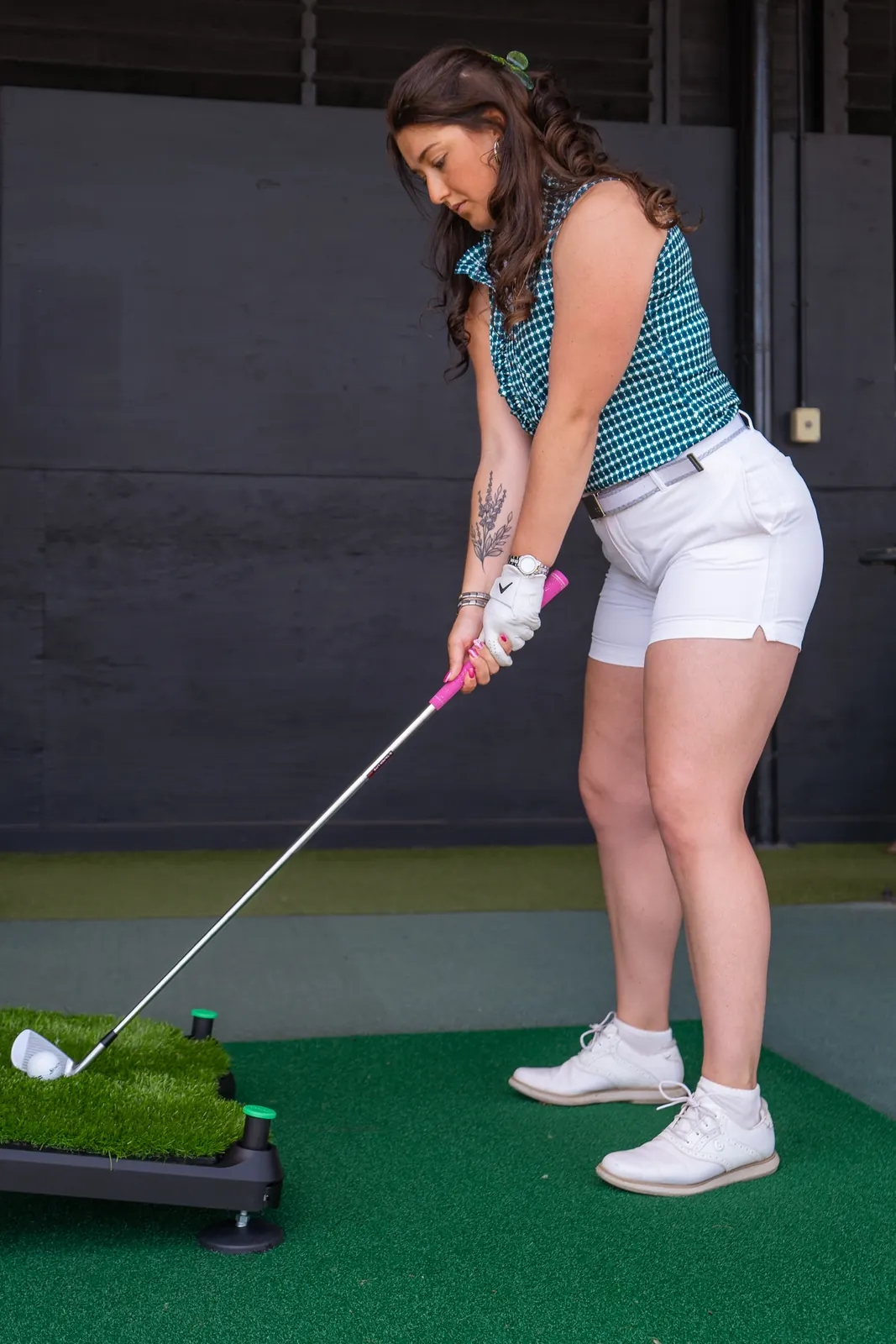
A good simulator session has four parts: a short warm-up, some technical work on one thing, a block where you change club and target every ball, and a bit of play at the end where every shot counts. Split an hour roughly 10, 20, 20 and 10 minutes and you'll get far more out of it than hitting driver until your arms ache. The plan below is built around that, with a weekly version if you're in the sim two or three times a week.
Why most sim sessions go nowhere
The usual sim session goes like this. Hit a few wedges, move to driver, hit 40 drivers, play nine holes of a famous course, go home. It's fun. It's also the same flat lie, the same target and very little thinking.
Most of it comes down to structure. Decide what the session is for before you walk in, and keep notes.

The 60-minute session
0 to 10 minutes: warm up with purpose
Start with a wedge, half swings. Then a 9-iron, a 7-iron, three-quarter swings building to full. Don't look at the numbers much yet. You're just getting the body moving and finding the middle of the face.
If the room's cold, take longer. A stiff back in a January garage is how people tweak something.
10 to 30 minutes: one technical job
Pick one thing. Just one. It might be start line with the 7-iron, a face-to-path number you're trying to shrink, or strike low point with wedges. If you're not sure which numbers to watch, our guide to launch monitor numbers for beginners covers it.
Hit in small groups of five. After each group, look at the numbers, then make one small change. A rehearsal swing or two between balls is fine. Twenty minutes of this is plenty; after that most people start tinkering with three things at once.
30 to 50 minutes: random practice
Now change club and target on every ball. Driver to a fairway, then a 6-iron to a green, then a 50-yard pitch, then a 9-iron. The software range mode usually lets you pick targets; if not, use the distance readout and set yourself a window.
This feels worse than the technical block. Your numbers will look messier. That's normal. Swapping clubs and targets is much closer to how golf works, and it's widely thought to help the skill stick. There's a plain explanation of why in block practice vs random practice.
50 to 60 minutes: play for something
Finish by playing three or four holes, or a set of ten shots with a score. Full pre-shot routine, one ball each time, no mulligans. If you want it to feel real, use your home course in the software if it's there, or pick a course with similar holes.
A weekly version
If you get into the sim two or three times a week, give each session a different job:
| Session | Main focus | Club mix |
|---|---|---|
| Session 1 | Strike and start line | Mostly irons and wedges |
| Session 2 | Long game and tee shots | Driver, woods, hybrid, long irons |
| Session 3 | Scoring | Wedges from 30 to 100 yards, then play holes |
Every session still starts with the warm-up and ends with a few shots that count.
Yardage gapping, once a month
Once a month, use a whole session to check your carry distances. Ten balls each, every club, and write down the typical carry. Ignore the one you flushed. It sounds dull, but carry yardages are the most useful thing a sim gives you, and they drift as your swing changes and the season goes on.

Add the lies the sim leaves out
Nearly every sim plan leaves one thing out. Every ball comes off a flat mat. On a course you'll play most of your approach shots from some kind of slope, and the shot changes. For a right-hander, ball above your feet tends to go left, below your feet right, uphill higher and shorter, downhill lower and running.
If you can recreate slopes in your setup, give them a slot in the random block. Rehearse the lies your course actually throws at you. Write down which holes give you which lie and practise those. Our post on rehearsing your home course explains how to build that list.
Keep a note
Two lines after each session is enough. What you worked on, what the numbers did, one thing for next time. Over a winter it shows you whether you've actually improved or just hit a lot of balls. There's a template in keeping a golf practice journal.
Quick answers
How long should a simulator session be? An hour is plenty for most people. Focused 45 minutes beats a tired two hours.
Should I play rounds on the sim or practise? Both. Practise first while you're fresh, play at the end.
How many balls should I hit? Fewer than you think. Around 60 to 80 with a routine on each is a solid hour.
If you want the slope slot in your plan to be repeatable, that's what Libro is for. It tilts up to 7 degrees along its length and 13 degrees across, sets with a cam lock, and has laser-engraved height lines so you can set the exact same lie next session and count reps on it. It works with any simulator. Reserve one for £10 ahead of Kickstarter in early 2027.