
You hit it fat from an uphill lie because the slope moves your low point, the spot where the club bottoms out. The ground in front of the ball is higher than the ground behind it, gravity keeps your weight on your trail foot, and if you swing as you would on flat ground the club runs into the hill at or just before the ball. To stop it, set your shoulders roughly parallel to the slope, nudge the ball a touch forward, and swing up the hill instead of into it.
This is for a right-hander, where uphill means your lead (left) foot is higher.
Low point, in plain English
Every swing has a lowest point. With an iron on flat ground, you want that point just in front of the ball, so the club hits the ball first and then takes a divot. Hit the ground before the ball and it's fat. Reach the ball after the low point, with the club rising, and it's thin.
On an uphill lie, the ground isn't level with your arc. The slope rises towards the target. So even if your swing bottoms out where it normally would, the ground has come up to meet it. The club catches turf when you weren't expecting it to.
The three usual causes
Swinging on a flat-ground arc
If your shoulders are level with the horizon instead of the slope, your arc is aimed at flat ground that isn't there. The club comes down and meets the rising slope at the ball, often digging in. The ball comes out low and weak, frequently left, with a big lump of turf.
Hanging back
Gravity holds you on your trail foot. That's fine at address on an uphill lie, but if you never get off it, the low point stays behind the ball. The club hits the ground first. This one feels like the classic heavy strike, a dull thud and a ball that goes half the distance.
Ball too far back
Some golfers instinctively move the ball back on any awkward lie. On an uphill lie, that's the wrong way. With the ball back, the club reaches it while still travelling down, straight into the rising ground. Mainstream advice is to move the ball a touch towards your higher foot, which uphill means a little forward.

How to stop hitting it fat
Start with your shoulders. Tilt them so they roughly match the slope, with your lead shoulder higher. This sets your swing arc parallel to the ground, so the club can travel along the slope through impact. It also puts a bit more weight on your trail foot, which is expected.
Move the ball a touch forward, around a ball's width on a gentle slope.
Then swing up the hill. The feeling is of sweeping the ball off the slope and finishing high, with the club following the ground up after impact. You still need to move through to your lead side. Not as much as on the flat, but enough that your chest faces the target at the finish.
Finally, take a practice swing next to the ball on the same slope. Watch where the club brushes the grass. That's your low point today, on this lie. If it's behind where the ball would be, you're still hanging back or the ball is too far forward. Use your practice swing to read a sloping lie explains the habit in more detail.
A note on leaning into the hill
Some players, especially on steep slopes with short irons, lean into the hill on purpose and hit a punchy shot. It can work, and coaches don't all agree on when it's the better option. But it puts the club on a steep path straight into the slope, which is a recipe for digging. If you're getting fat contact, go with the slope first.

What to expect when you strike it cleanly
Once you're not hitting it fat, the ball flies higher than normal because the slope adds loft. It also tends to go left. So you'll usually need more club and an aim a little right of target. The uphill lie pillar has the full set-up and club choice.
Why the range hides this
Fat shots on a flat range mat are easy to miss. The club bounces off the mat into the ball, and the shot often looks fine. On real turf, especially on a slope, the same strike digs in and costs you half the distance. If you mostly practise on mats, hitting mats vs real turf explains what else gets hidden.
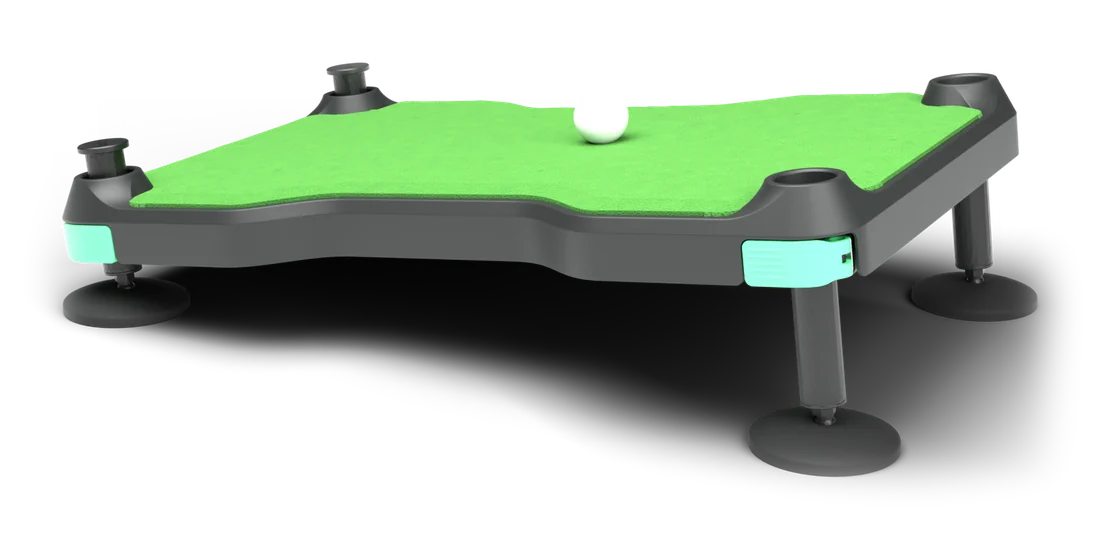
The low point on a slope is something you only learn by feeling it, over and over, until the right arc feels normal. Libro is a portable platform that tilts to recreate uphill lies, up to 7 degrees along its length, so you can work on your low point on a slope instead of finding out on the 14th. It's coming to Kickstarter in early 2027, and you can reserve one for £10, fully refundable.