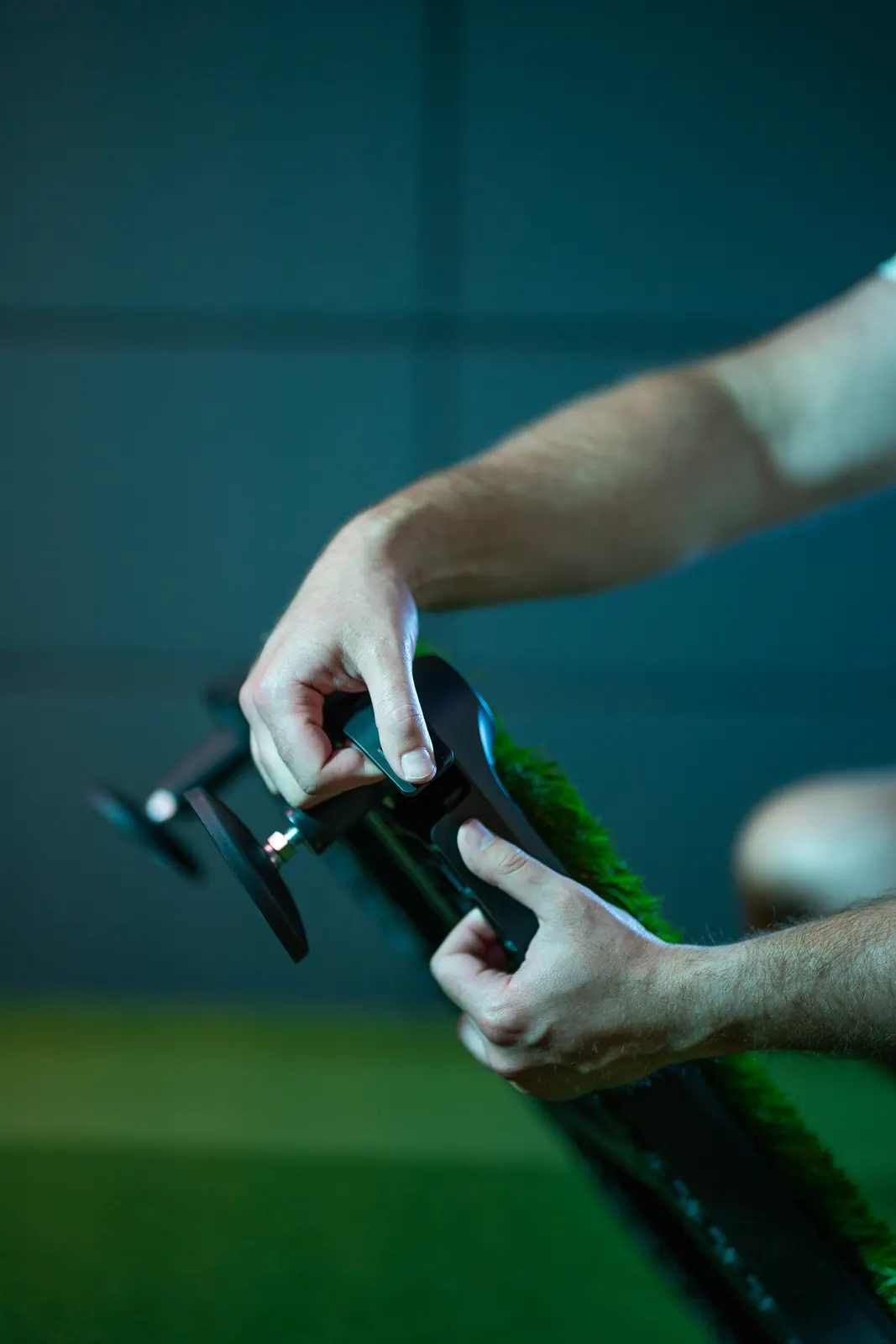
Libro sets a lie in seconds with a cam lock. You tilt it to the slope you want, up to 7 degrees along its length for uphill and downhill or 13 degrees across for ball above or below your feet, then lock it. Laser-engraved height lines show you where you set it, so you can come back to the same lie tomorrow, next week or next month.
That last part matters more than the tilt itself.
Why speed matters
If changing the lie takes a toolbox and five minutes, you won't do it mid-session. You'll set one slope, hit a bucket off it and call it done. That's still better than flat, but it isn't how the course works. On the course, the lie changes every shot.
Because the cam lock takes seconds, you can switch between lies as often as you like. Hit three off an uphill lie, three with the ball below your feet, three flat. That kind of mixed practice is closer to a real round, and there's a sensible case for it in block vs random practice.
Why repeatable matters even more
A slope you can't repeat is hard to learn from. You have a good session on Tuesday, come back on Saturday, set it up by eye and it's a different lie. You've no idea whether your strike got worse or the ground changed.
The laser-engraved height lines fix that. Note which line you used and you can set exactly the same lie again. That lets you do the things that make practice add up over weeks:
- Count reps on one specific lie, the same way you'd count putts from four feet.
- Change one thing in your set-up and know the slope stayed the same.
- Go a line steeper once a lie starts to feel comfortable.
Write it down. A line in a golf practice journal like "ball below feet, same line as last week, 20 balls, half started right" tells you more in a month than any memory of how it felt.

Setting it up, step by step
- Pick the lie. Start with the one your course gives you most, or the one that costs you most. If you're not sure, think about where your bad holes come from.
- Tilt it. Along the length for uphill or downhill, across for a sidehill lie.
- Lock it with the cam lock.
- Check the height line and make a note of it.
- Hit. Use your launch monitor or sim if you have one, or just a net or the range.
Nothing to charge and no subscription to sign in to.

A first session on Libro
Here's a simple way to start, which takes about half an hour.
Hit five balls flat with a 7-iron to get a baseline. Then set a gentle uphill lie and hit ten. You should see the ball fly a bit higher and start a bit left (for a right-hander). Go back to flat for five, then set a gentle downhill lie for ten. Expect it lower, and a touch right.
Finish with five shots where you change the lie every ball. That last block is the one that feels hardest, and the one that's most like playing. If you want more structured ideas, the uneven lie drills work well on Libro.
What you can set
| Direction | Lies it gives you | Range |
|---|---|---|
| Along its length | Uphill, downhill | Up to 7 degrees |
| Across | Ball above feet, ball below feet | Up to 13 degrees |
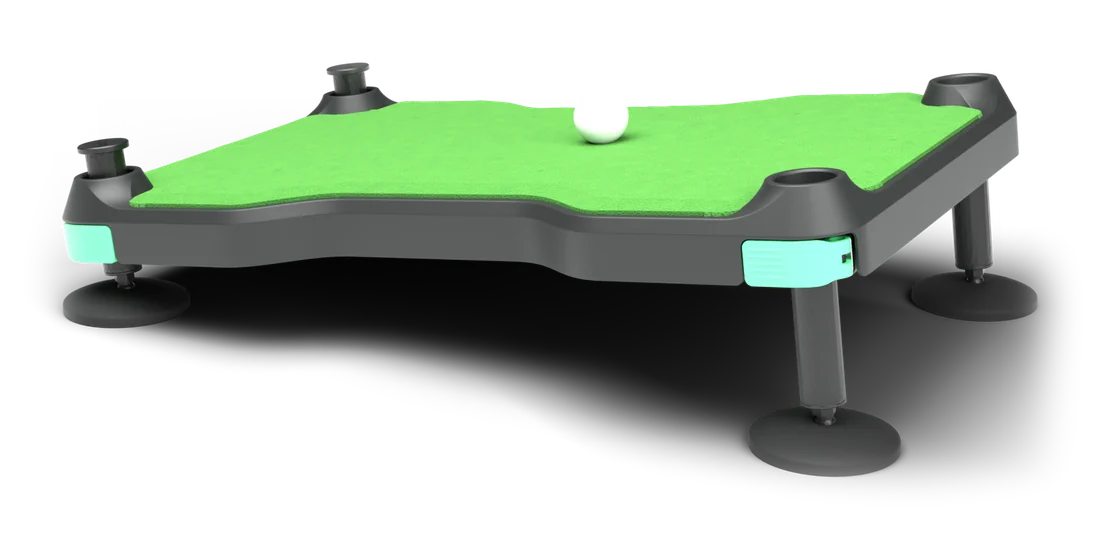
Libro is 670 x 420 mm, 136 mm high and weighs 4.97 kg, with materials rated well beyond 250 kg. It's coming to Kickstarter in early 2027, and you can reserve one for £10, fully refundable.