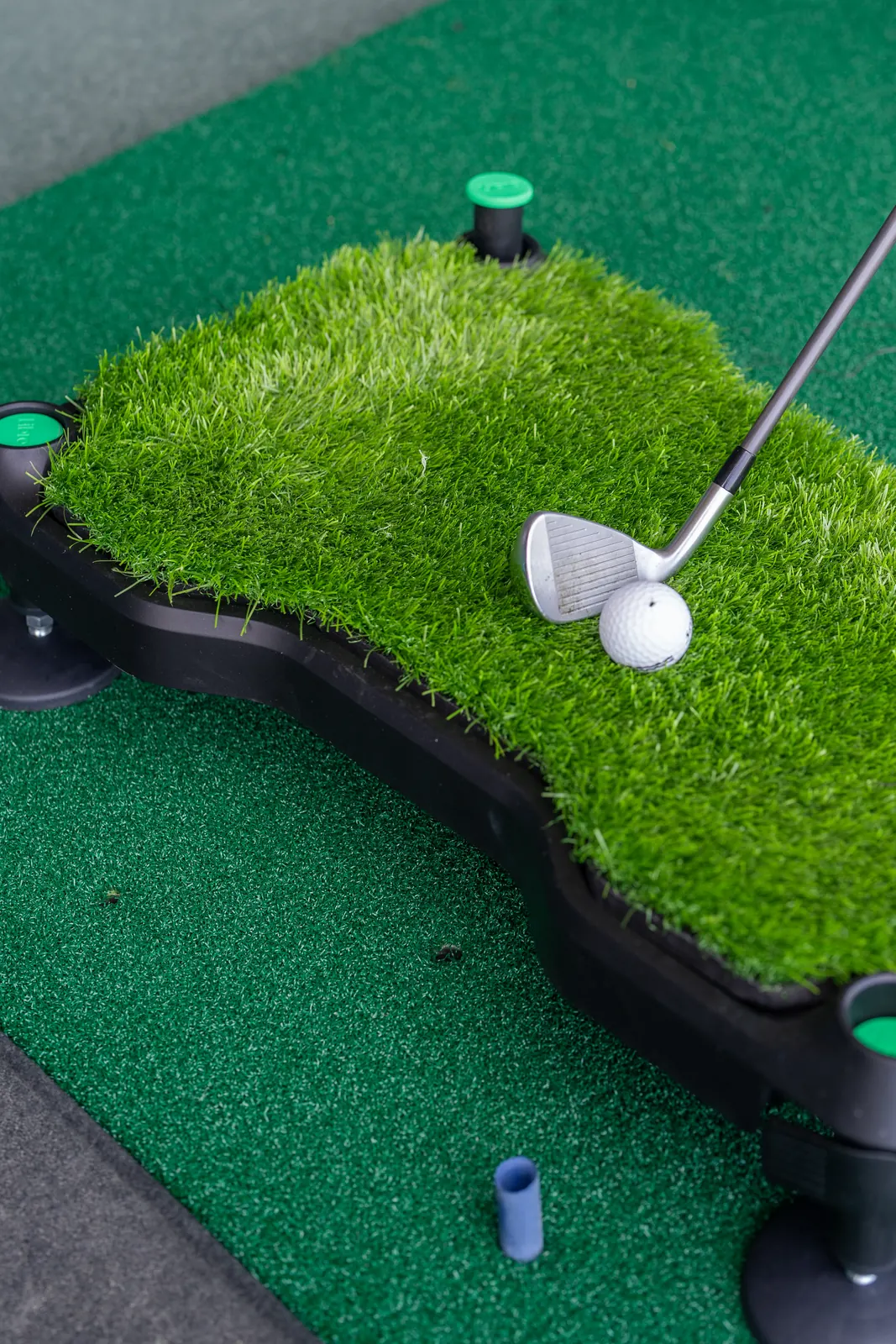
Practising only on a flat range mat holds your game back because it trains you for a lie you almost never get on the course. Outside the tee box, a large share of your shots are played with the ball a bit above, below, uphill or downhill of your feet, on real grass. The mat is level, it forgives fat shots, and it gives you the same lie every time. You get good at hitting off the mat, and then the course asks for something else.
I'm not saying stop going to the range. It's a good place to work on your swing. But if the range is all you do, you're missing a big part of what scoring actually needs.
The mat lies to you in two ways
It's flat. Every ball on the range sits on a perfectly level surface. Your feet are level, the ball is level with them, and your balance never gets tested. The tee box is the only flat lie you get on most courses, so the range is effectively rehearsing your tee shots and not much else.
It's forgiving. Hit a few inches behind the ball on a mat and the club bounces off the hard surface into the ball. You'll often get a decent-looking shot. Do that on soft turf and the club digs, and the ball goes nowhere. Mats hide fat shots. The post on hitting mats vs real turf has more on this.
Put those together and you have a practice surface that removes the two things that cause most bad shots from the fairway: the slope moving your low point, and the ground punishing you when the low point is wrong.

It also trains a single, repeated lie
The other quiet problem is repetition. On the range, you hit the same club off the same lie at the same target, ball after ball. That feels productive. You get into a groove and the shots get better.
But on the course you never hit the same shot twice in a row. Every lie, club and target is different. Coaches who study how skills transfer generally favour mixing things up, changing club, target and situation between shots, because it makes practice more like the real thing. The block vs random practice post explains the idea without the jargon.
A flat mat makes it impossible to change one of the most important variables, the lie itself.
What happens on the course
You've been hitting your 7-iron well all week. Lovely high draws off the mat. Saturday, your drive finishes on a gentle downslope in the fairway, ball a little below your feet. You set up as you have all week and make the same swing.
The slope has moved the bottom of your arc back, so the club catches the ball thin. The face is tilted right because of the below-feet slope. Your weight drifts forward. You hit a low push into the right rough and walk off wondering why your range form disappeared.
It didn't disappear. You just never practised the shot you were faced with.

What you can do about it
The good news is you don't need to give up range sessions. You need to add slopes and variety to them.
Use the slopes you can find. Many ranges have grass tee areas at the edges, or short-game areas with banks and run-offs. Hit some shots from there. Even a gentle slope teaches you something. Practising uneven lies at the range has more ideas.
Change something every shot. Don't hit twenty 7-irons. Hit one 7-iron, one wedge, one hybrid, each to a different target, with a full routine each time.
Practise on the course when you can. Quiet evenings on the course, if your club allows it, are the best slope practice there is. Drop a ball on a slope, play it, and see what happens.
Get a slope at home. A garden bank, a DIY board, or a proper tilting platform. Each has trade-offs, but any slope beats none.
Keep your range work for what it's good at. Swing changes, contact drills, distance checks, warming up. All useful. Just don't confuse a good range session with being ready for the course.
The honest middle ground
Some coaches would say a solid, repeatable flat-lie swing is the foundation, and that you should get that right before worrying about slopes. That's reasonable, especially for beginners. If you can't strike it from a flat lie, a slope will only make things worse.
But once you can hit a decent shot off the mat, more flat-lie reps give you less and less. That's the point where slope practice starts paying back, because it trains the adjustments the course keeps asking for.
This is exactly why Libro exists. It's a portable platform that tilts to recreate uphill, downhill and sidehill lies, up to 7 degrees along its length and 13 degrees across, and it works at the range, in a sim bay or at home. Feel what's real. You can reserve one for £10, fully refundable, ahead of the Kickstarter in early 2027.