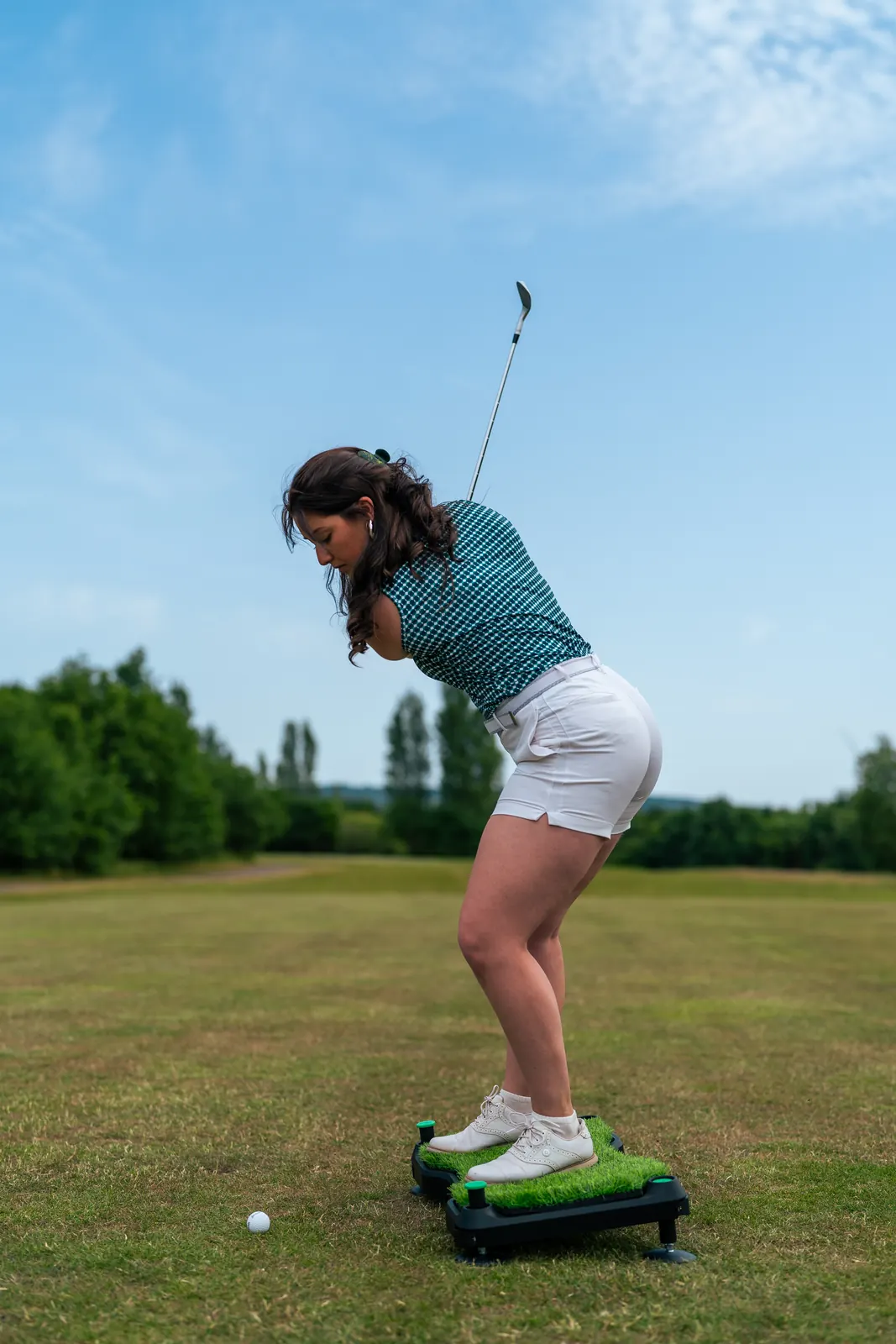
Twenty minutes is enough to improve, as long as you stop hitting the same 7-iron at the same flag over and over. The plan below splits the time into four short blocks: a warm-up, a skill block, a mixed block where every ball is a different shot, and a finish with something on the line. It works at a range, in a sim bay or in the garden with a net.
Most of us have more twenty-minute windows than two-hour ones. Before work, after the kids are in bed, the gap between a lesson and the bar. The trick is to use that time on practice that looks a bit like golf.
The plan at a glance
| Minutes | Block | What you do |
|---|---|---|
| 0 to 4 | Warm up | Half swings with a wedge, then a few full ones |
| 4 to 9 | Skill | One thing you're working on, one club |
| 9 to 17 | Mixed | Change club, target or lie every ball |
| 17 to 20 | Pressure | A small game you can win or lose |
That's roughly 30 to 40 balls if you take your time. Fewer is fine. If you're getting through a basket of 80 in twenty minutes, you're raking and hitting, and that's mostly exercise.

0 to 4 minutes: warm up without fuss
Grab a sand wedge or pitching wedge. Hit a handful of hip-high to hip-high swings, just making clean contact. Then five or six fuller swings at about 70 percent. You're waking up the body and finding the bottom of the swing, nothing more.
Don't judge anything here. A shank in the first two minutes means nothing.
4 to 9 minutes: one thing, done properly
This is the only part of the session that looks like traditional range practice. Pick the single thing your coach gave you, or the one fault you know costs you most. A takeaway feel. Better ball-first contact. Stopping the slice.
Use one club and one target. Hit a ball, check the result, have a practice swing with the feel, hit again. Slow down between balls. Ten good-quality reps beat thirty rushed ones.
If you have no swing change on the go, use this block for contact. Put a tee peg or a towel a few inches behind the ball and try to miss it. On a mat, it's easy to get away with a heavy strike that would have taken a divot the size of a dinner plate on grass, so be honest about how it felt.
9 to 17 minutes: every ball different
Here is where the transfer happens. On the course you never hit the same shot twice in a row, so in this block you don't either. The research idea behind this is covered in block vs random practice, but the short version is that mixing things up feels worse in the session and holds up better later.
Play a made-up hole sequence. For example:
- Driver at a target, pick a fairway between two markers.
- 7-iron to a green.
- 9-iron to a closer flag.
- Wedge to the nearest target.
- Back to driver.
Go through your full pre-shot routine for each one. Stand behind the ball, pick a target, take your practice swing, commit. If that sounds slow, good. It's how you'll play on Saturday.
If you have any way to change the lie, use it in this block. Hit one from a slight slope in the garden, one off a flat mat, one with the ball a little above your feet. Even two or three sloping-lie shots per session adds up over a winter, because the course rarely gives you the flat lie you get on the range. Range practice on a flat mat is fine for building a swing, but it can't teach you how a slope moves your low point.
17 to 20 minutes: finish with a score
End with something you can pass or fail. A few ideas:
- Nine-ball challenge. Three wedges, three mid-irons, three drivers. Each one that finishes inside your chosen window scores a point. Write the score down and try to beat it next time.
- Up and down simulation. Hit a wedge, then go and chip and putt if you're at a short game area. Count how many you get down in two from five tries.
- Last ball rule. Your final ball has to be a good one. If it isn't, you hit one more, and so on, but only twice. Then you leave whatever happened.
A bit of consequence makes you care about the shot in front of you, which is what a round feels like.
How to adjust it
Short game only? Swap the blocks. Warm up with putts, do skill work on chipping, then mix chips, pitches and bunker shots in the middle block, then finish with a "get down in two" game.
Got thirty minutes? Stretch the mixed block. That's the bit that pays off.
Only ten minutes? Skip the skill block and go straight from warm-up to mixed shots. If you can only do one block well, make it the one that looks like golf.
If you want a fuller structure across a whole week, how often to practise golf goes into frequency and how to spread sessions out.
Quick answers
Is 20 minutes of practice worth it? Yes, if it's focused. Short regular sessions are easier to keep up than one long one a month.
How many balls should I hit in 20 minutes? Around 30 to 40 with a routine on each. Much more than that and you're rushing.
Should I putt or hit balls if I only have 20 minutes? Depends where you lose shots. If three-putts are killing your card, putt.
The mixed block works best when the lies change as well as the clubs. Libro is a portable platform that tilts up to 7 degrees along its length and 13 degrees across, so you can drop a sloping lie into a garden or sim session in seconds and set the same one again next time using its engraved height lines. It's coming to Kickstarter in early 2027, and you can reserve one for £10, fully refundable.