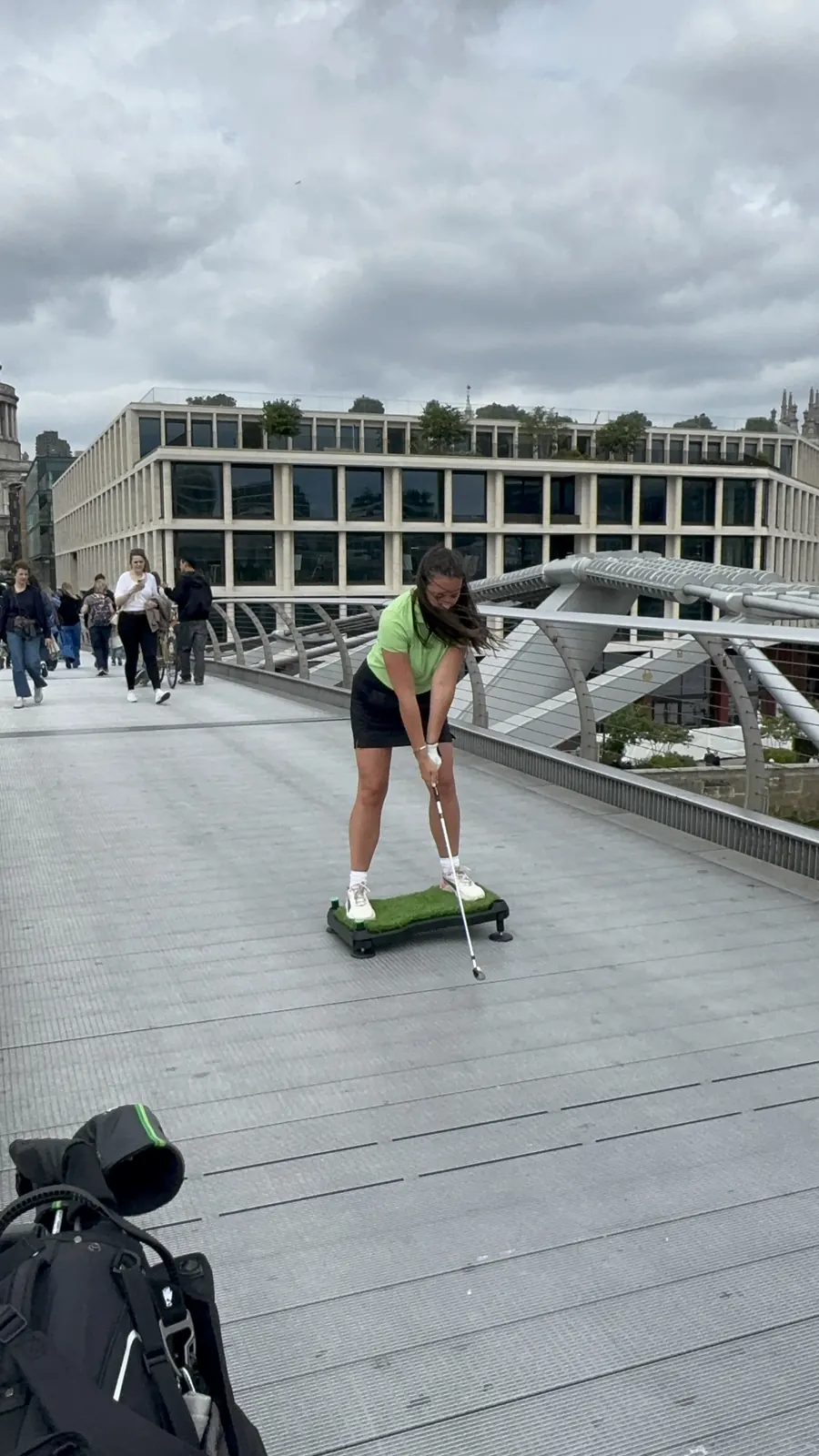
You can practise uneven lies at home in four main ways: on a slope in your garden, with a DIY sloped board, with posture work in front of a mirror, or on a tilting platform built for the job. A garden slope is free but you only get the one slope you've got. A mirror and a book under your foot teach posture but not contact. A purpose-built platform gives you any lie on demand. Most people end up mixing two of these.
Before anything else, think about safety and space. Full swings indoors need plenty of ceiling height and room around you. Hitting real balls at home needs a proper net and a safe area. If you're not sure, stick to practice swings and foam or plastic balls.
Option 1: your garden
If you've got a bank, a rise or a lawn that falls away, you've got a slope. That's a real advantage.
What it's good for. Chipping and short pitching from real grass on a real slope. You'll learn how the ball reacts off an uphill bank compared to a downhill one, and how your strike changes. With a net, you can hit full shots too, as long as the space is safe.
The limits. You get one slope, at one steepness, facing one way. You can usually turn around to get the opposite lie (uphill becomes downhill, ball above feet becomes below), but you can't make it steeper or gentler. Your lawn also won't thank you for daily divots. And in a UK winter, it may be under water for weeks.
Tip: if you chip in the garden, use a mat on the slope for some of your shots to save the lawn. You lose a bit of realism but keep the slope.
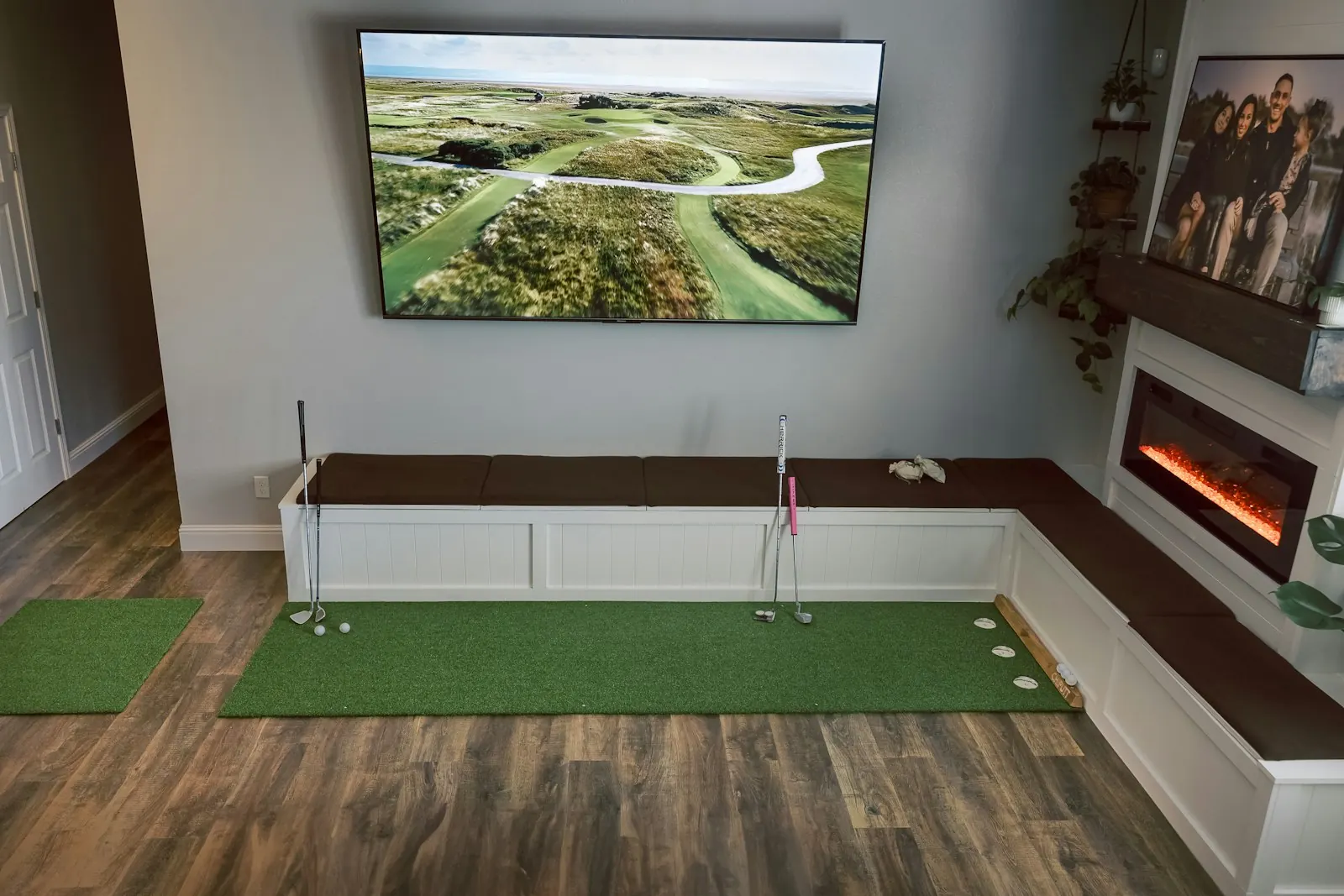
Option 2: DIY sloped boards
Plenty of golfers have built a wedge-shaped board from plywood, with a hitting mat on top. It's a fair project if you're handy.
What it's good for. A consistent slope you can use indoors or in a garage, on a mat, with a net.
The limits. It's one angle, unless you build several. Getting the build stiff enough to stand and swing on takes care, and a board that flexes or slides is a safety risk. A mat on a hard board is also very forgiving of fat shots, like a range mat. The post on DIY sloped practice goes through the options and where they fall short.
Option 3: mirror and posture work
This needs no equipment and no space for full swings.
Stand side-on to a mirror. Put a thick book or a step under one foot to fake an uphill or downhill stance, and practise setting your shoulders along the slope. Then try it with your toes raised or lowered to feel ball above and below your feet. Make slow swings and watch whether your shoulders and spine angle stay where you set them.
What it's good for. Posture, shoulder tilt and balance. It teaches your body what each set-up should feel like, which helps when you see the lie on the course.
The limits. There's no ball, so there's no feedback on contact or flight. It's also only an approximation of the stance, because the ground under the ball isn't tilting. It's a rehearsal and a good one, but it won't tell you whether you'd have hit it fat.

Option 4: a sloped mat or tilting platform
There are two kinds of product here.
Sloped mats are mats with a fixed slope built in, sometimes with interchangeable wedges underneath. They're simple. Most give you a limited range of lies.
Tilting platforms let you change the slope and the direction. At the top end, motorised stages used in some studios and academies cost £20,000 or more, which puts them out of reach for most home setups. Manual tilting platforms do a similar job by hand, without the motors. The post comparing sloped mats vs tilting platforms is honest about the trade-offs.
What they're good for. Any lie you want, the same lie every time, and full shots into a net or a simulator. They're the only home option that gives you all four slopes at different steepnesses.
The limits. Cost and space. You still need room for a full swing and a safe hitting area.
Making home practice count
Whichever option you use, a few things help:
- Change lies often. Don't hit twenty balls from the same slope. Mix them up so it's more like the course.
- Use the same lie twice. To see improvement, you need to come back to the exact same slope. Mark your garden spot, or note your board's angle.
- Keep a short note. Lie, club, what happened. The golf practice journal post has a simple format.
- Practise your practice swing. Rehearse finding the low point on each slope. That habit carries straight on to the course.
- Watch the ball if you can. A net is fine for contact. A launch monitor or simulator shows you the flight change, which is what you really want to learn.
What I'd do
If you have a garden slope and a net, start there. It's free and it's real grass. Add mirror work for posture on evenings when it's dark or wet. If you find yourself wishing you had more lies, or you use a home simulator and want slopes in it, that's when a platform starts to make sense.
Libro is a portable platform that tilts up to 7 degrees uphill or downhill and 13 degrees across, set in seconds with a cam lock. It measures 670 by 420 mm and weighs 4.97 kg, so it fits a garage, a garden or a sim bay. It needs no batteries or charging and works with any launch monitor or simulator, or on its own. You can reserve one for £10, fully refundable.