
On flat ground, the ball moves forward in your stance as the club gets longer: centre for wedges, a little ahead of centre for mid irons, further forward for long irons and hybrids, and inside your lead heel for the driver. On a slope, the simple rule is to move the ball towards your higher foot. That means a touch further forward on an uphill lie and further back on a downhill lie. On sidehill lies, keep it roughly where it would be on flat ground and change your distance from it instead.
All of this assumes a right-hander, so "lead foot" is your left.
Why ball position moves with the club
Your swing has a low point, the spot where the club is at the bottom of its arc. With an iron you want to hit the ball just before that low point so you strike ball first, then turf. With a driver off a tee you want to catch it slightly after the low point, on the way up.
Longer clubs have a wider arc and you stand further from the ball, so the low point drifts a bit further forward. That's why the ball creeps up your stance as you go through the bag.
On a slope, the ground tilts against your arc. The club tends to meet the ground nearer your higher foot, because that's where the ground rises up to meet it. On an uphill lie that point moves forward, and on a downhill lie it moves back. Putting the ball towards the higher foot keeps it where the club actually meets the ground on that slope.
The table
These are starting points, not fixed laws. Coaches describe ball position slightly differently and your build matters. Use the table, then check it with a practice swing.
| Club | Flat lie | Uphill lie | Downhill lie |
|---|---|---|---|
| Wedges, 9-iron | Middle of stance | A touch forward of middle | One to two balls back of middle |
| 7 and 8-iron | Just forward of middle | A ball further forward | Middle, or a touch back |
| 5 and 6-iron, hybrids | A ball or two forward of middle | Further forward again | Middle to just forward |
| Fairway woods | A few inches inside lead heel | Close to lead heel | Back from normal, if you take it at all |
| Driver (on a tee) | Inside lead heel | Rarely relevant off the deck | Rarely relevant off the deck |
Fairway woods off a downhill lie are a gamble for most club golfers. The question of whether to try is covered in fairway woods from a downhill lie.
How far is "a touch"?
Think in ball widths. On a gentle slope, one ball's width is plenty. On a steep one, two or more. If you move it too far, you'll see it. Too far forward on an uphill lie and you hit it on the up, high and weak. Too far back on a downhill lie and you hit down so steeply that the ball comes out very low and the face often stays open.

Sidehill lies
Sidehill lies change how far the ball is from you more than where it sits between your feet.
- Ball above your feet. The ball is closer to your hands. Keep it in its usual spot, stand a little taller and grip down. Your swing will be flatter, which is normal. More in ball above your feet.
- Ball below your feet. The ball is further away. Keep its usual position, widen your stance a bit, flex your knees more and hold the club at full length. Some golfers like it a fraction back to make sure they strike down, but that's a small tweak.
Use your practice swing to check
Every slope is different, so don't trust a table blindly. Take two practice swings next to the ball, on the same slope, with the same set-up. Watch where the club brushes the ground. That brush mark is your low point. For an iron, put the ball just behind it, so you strike the ball before the ground.
This is the single most useful habit on a sloping lie, and there's a whole post on it: use your practice swing to read a sloping lie.
Common mistakes
Moving the ball the wrong way is more common than you'd think, usually on downhill lies where it feels natural to put the ball forward to "help it up". Don't. The loft will get it up, and the slope is already taking loft off.
The other mistake is moving the ball and nothing else. Ball position works with the rest of the set-up. If your shoulders aren't roughly parallel to the slope, the new ball position won't line up with your arc. The four uneven lies explained covers how the pieces fit together.
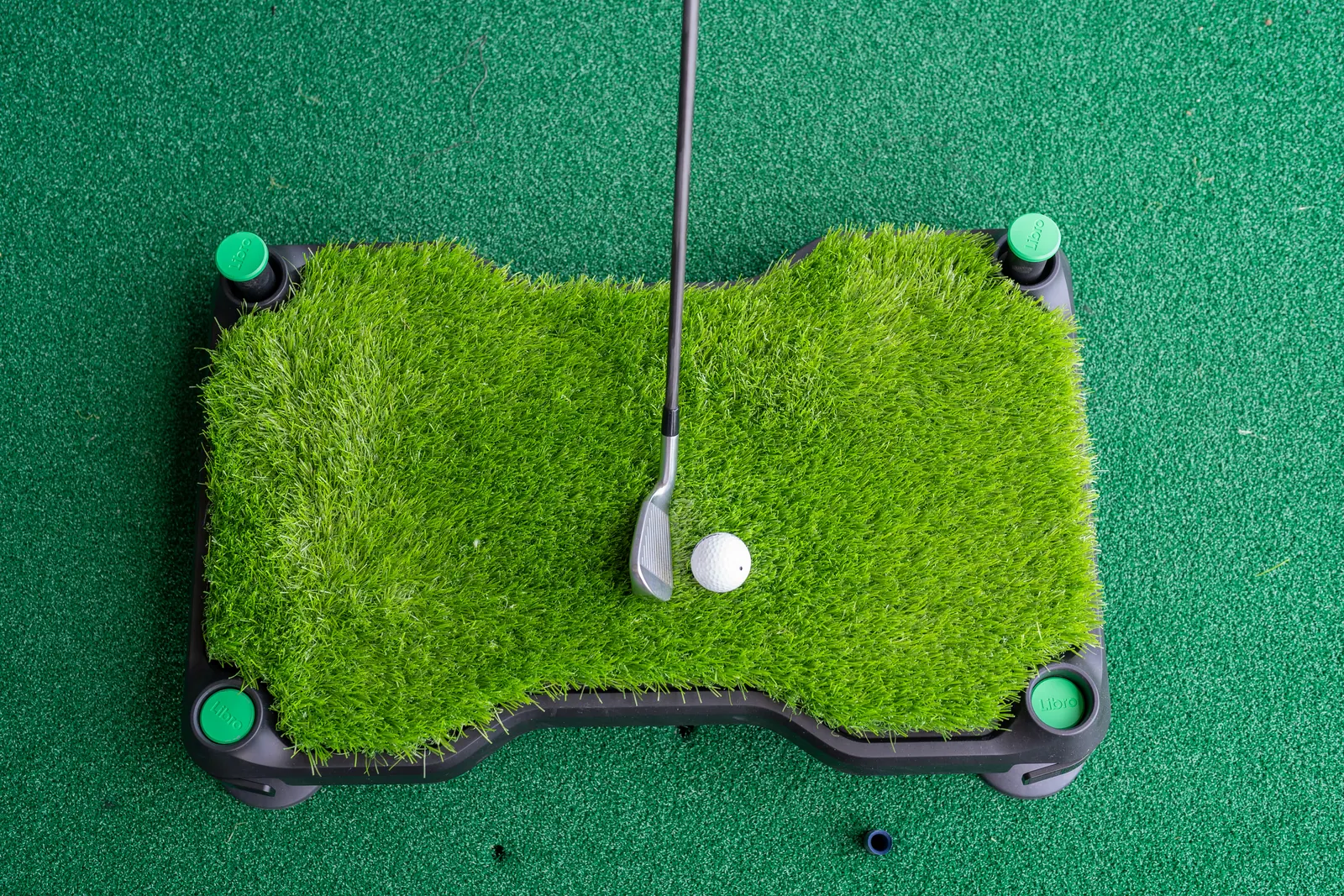
Ball position on a slope is a feel you only build by hitting off slopes. Libro is a portable platform that tilts to recreate uphill, downhill and sidehill lies, and its engraved height lines mean you can set the same lie again to test different ball positions on it. It's coming to Kickstarter in early 2027, and you can reserve one for £10, fully refundable.