
On most sloping lies, let your weight sit with the slope at address. On an uphill lie that means a bit more on your trail (lower) foot. On a downhill lie it means more on your lead (lower) foot. On sidehill lies you lean against gravity instead: towards the balls of your feet when the ball is above them, and back towards your heels when it's below. Then make a smaller, balanced swing so the slope doesn't tip you over.
All of this is for a right-hander. Flip it if you're left-handed.
The set-up for each lie is covered in the pillar posts. This one is about the weight itself, because that's where most of the bad contact on slopes comes from.
Why weight goes wrong on a slope
On flat ground your weight moves to the trail side in the backswing and back to the lead side through the ball. Simple enough. On a slope, gravity is either helping or fighting that move, and your body notices before your brain does.
Uphill, gravity pulls you back. Getting to your lead side is hard work, so you hang on the trail foot and the club bottoms out behind the ball.
Downhill, gravity pulls you forward. Getting to your lead side is easy. Too easy. The usual fault is the opposite reaction, where you sense the fall and pull back against it, often lifting the chest to try to help the ball up.
Sidehill lies pull you towards or away from the ball, and the swing becomes a battle to stay in posture.
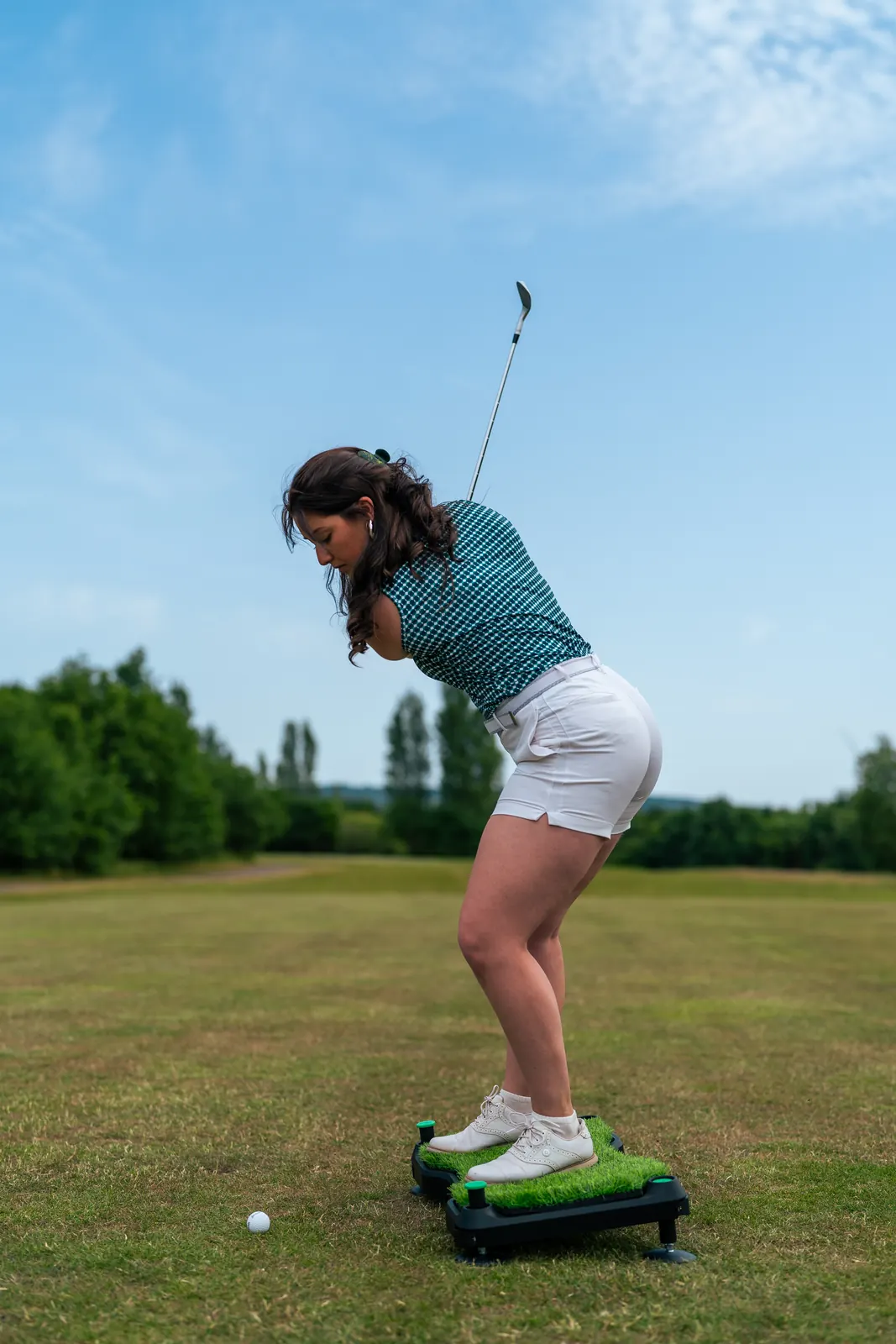
Uphill: with the slope, then work through it
The mainstream advice for full shots is to set your shoulders roughly parallel to the slope. Doing that naturally puts more weight on your trail foot. That's fine. It lets the club swing up the hill instead of crashing into it.
The trouble starts if you stay there. You still need to move through the ball, even though it feels like walking uphill with a rucksack on. Aim to finish with most of your weight on the lead foot and your belt buckle facing the target, even if the finish is shorter than normal.
Coaches don't all agree on steep uphill lies. Some prefer leaning into the slope, more weight on the lead foot, for a lower punch shot, especially with short irons near the green. It works, but the club digs in more and the ball tends to come out low and left. If you're new to slopes, go with the slope first. The full set-up is in how to hit off an uphill lie.
Downhill: lead foot loaded, and stay there
On a downhill lie, shoulders roughly parallel to the slope means your lead shoulder sits lower and more weight goes on your lead foot. Keep it there for the whole swing. Don't let it rock back to your trail side in the backswing, because you'll struggle to get it back down the hill in time.
Through the ball, chase the clubhead down the slope. Your weight moves further onto the lead side and your finish may feel like you're about to walk after the ball. Let it. Pulling back is behind a lot of the thin and topped shots people hit from these lies. See how to hit off a downhill lie for the rest of the set-up.
Ball above your feet: weight a touch forward
The slope pushes you back towards your heels. Set up with your weight a bit more towards the balls of your feet so that you stay balanced as you swing. Stand a little taller, since the ball is closer to you. If you fall back on to your heels through impact, the club tends to swing even flatter and the ball goes even further left.

Ball below your feet: sit back towards your heels
Here the slope tips you towards the ball. Flex your knees more, sit back a touch towards your heels and keep that knee flex all the way through. The classic miss is standing up out of the shot, which leads to thins and shanks as well as the usual push right. There's more on it in ball below your feet.
A quick reference
| Lie (right-hander) | Weight at address | What the slope tries to do |
|---|---|---|
| Uphill | More on trail foot | Keep you back |
| Downhill | More on lead foot | Pull you forward, tempt you to hang back |
| Ball above feet | Towards balls of feet | Push you onto heels |
| Ball below feet | Towards heels, more knee flex | Tip you towards the ball |
The balance check
The simplest test of whether your weight was right is your finish. If you can hold it for a count of three without stepping, your weight was close enough. If you stumble down the hill or rock back up it, it wasn't. That's why the 80 percent swing is such good advice on slopes. Less speed, less for gravity to work with.
The hard part with all of this is that you can't really rehearse it on a flat range. Libro is a portable platform that tilts to recreate uphill, downhill and sidehill lies, so you can feel where your weight wants to go on each one and practise holding your balance before it matters on the course. You can reserve one for £10, fully refundable.